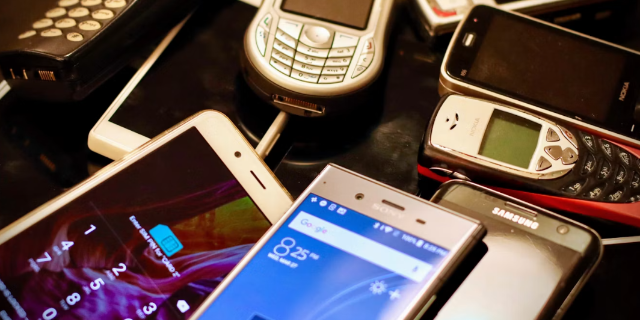
A growing number of young people are ditching their smartphones for "dumb phones" in search of quiet, focus and a little bit of their lives back.
Over a recent three-year stretch, 18- to 24-year-olds led a 148% spike in "brick phone" sales — while their smartphone use dropped 12%. Experts are calling the shift a "dopamine diet."
"Smartphones have the same chemical reaction in the brain as other addictive habits," said Melissa DiMartino, associate professor of psychology at the New York Institute of Technology. "Looking at your phone to feel better becomes an addictive cycle that ultimately leads people to feel depressed and lonely."
The brick phone comeback started with product nostalgia, then caught fire online. Generation Z has made retro communication cool again. The company behind Nokia's famous 3310 said that after bringing the model back, sales had doubled within a few years.
Gen Z is also the only age group shrinking its digital footprint. A recent report found that the average number of connected devices they own has fallen from 5.3 to 5.0, even as the national average rose slightly from 5.0 to 5.1.
"I've always hated being available to everyone," said Gen-Z music producer Rana Ali. "The idea that if you send a message to someone and they don't respond immediately, then something's wrong."
Young people might be onto something. One study found that blocking mobile internet access — while still allowing calls and texts — improved mental health, attention and well-being. After two weeks offline, 91% of participants felt better. Researchers said the extra time went to socializing, exercising or going outside.
That is what members of New York City's "Luddite Club" gather each week to do: spend phone-free hours in a park talking, painting or reading. "My days are eight hours longer," said Jameson Butler, a high school student who joined after his screen time spiked. "What we're seeing right now is an abuse of technology — not its use," said former teacher Amanda Hanna-McLeer.
More than one-fifth of Gen Z say they wish smartphones had never been invented. In a survey of about 1,000 young adults, nearly half wished some of the most popular social apps didn't exist.
For 19-year-old Caleb, quitting felt extreme, but it was worth it. "I put my smartphone in a cardboard box, wrapped it in three layers of duct tape and said goodbye to it for a week," he said. He got used to it. Now he carries a flip phone, a notebook and an MP3 player. "I'd much rather write about my experiences in a journal, because it feels so much more personal," he said.
New York artist August Lamm took a slower route. She would take the phone back for an audiobook or directions, then get sucked in again. She hasn't owned a smartphone for years. "Once you're deprived of that option, you figure it out," she said.
"Do Not Disturb" mode doesn't always help. "Once you open that phone, it's like you just opened up Pandora's box," said digital media professor Ari Lightman. "There's a sort of cascading series of actions that basically snap up all your time."
These young digital minimalists say dumb phones break the loop. "Older systems allow people to focus on one activity at a time, instead of being overrun by algorithms," said sociologist Caitlin Begg.
Still, switching is hard in a culture built around smartphones. One 24-year-old said she wants to feel more connected to the world around her, "rather than passively listening, watching and wasting away hours I can't get back."