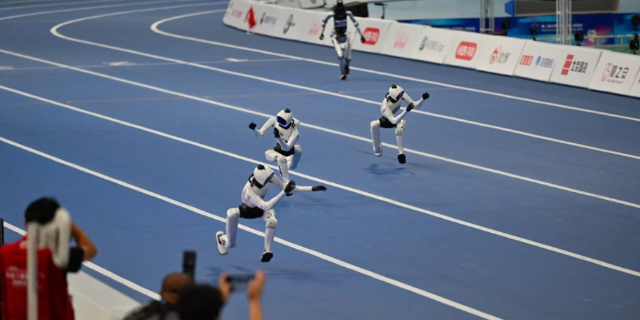
A humanoid robot raced to victory in Beijing with an unusual running style: It leaned forward, swung its hips from side to side and held both hands close to its face.
Online viewers thought it looked like a shy person trying to hide. But the robot wasn't embarrassed, and its developers hadn't taught it to run that way. It had discovered the posture on its own.
The robot, named Tien Kung Omni, competed in the 400-meter small-group final at the second World Humanoid Robot Games. It completed the race in 45.66 seconds and took first place.
Engineers had originally designed it to move its arms like a human runner. During training in a simulated environment, however, the robot repeatedly tested different movements. A reward system encouraged it to find an effective way to complete the race. After many attempts, it settled on the strange hands-up posture because it worked better for its mechanical body.
A human sprinter swings their arms rapidly to stay balanced and generate power. For a robot, that movement can put too much pressure on the shoulder joints. The joints may become hot, while the repeated motion also uses extra energy. Over 400 meters, the robot might tire before reaching the finish line.
Keeping its hands near its face reduces the workload on its arms. The robot can then save energy for its legs and maintain a high speed throughout the race. What looks awkward to humans is actually an efficient solution to a mechanical problem.
Different races create different challenges for humanoid robots. In a half-marathon, the hip joints must operate for a long time, so engineers need to prevent them from overheating. In shorter events such as the 100-meter and 400-meter races, the hips face less pressure, but speed, balance and energy use become more important.
Tien Kung Omni wasn't the only fast robot at the event. Another model from the same company, Tien Kung Ultra, finished a 400-meter race in 38.15 seconds. That was faster than the men's human world record of 43.03 seconds.
The comparison does not mean robots are ready to replace human athletes. Robot competitions follow different rules and involve machines built specifically for the track. Still, the result shows how quickly the technology is improving. At the first edition of the games a year earlier, the winning robot needed 1 minute and 28.03 seconds to cover the same distance.
The next big test will take robots away from smooth running tracks. In the real world, they must handle uneven ground, unexpected objects and outside forces while completing useful tasks. Those situations are far more complicated than running in a straight line.
For now, Tien Kung Omni has already taught its developers an interesting lesson: The most effective way for a robot to move may not look human at all. Sometimes, innovation begins when a machine stops copying us and finds its own style.