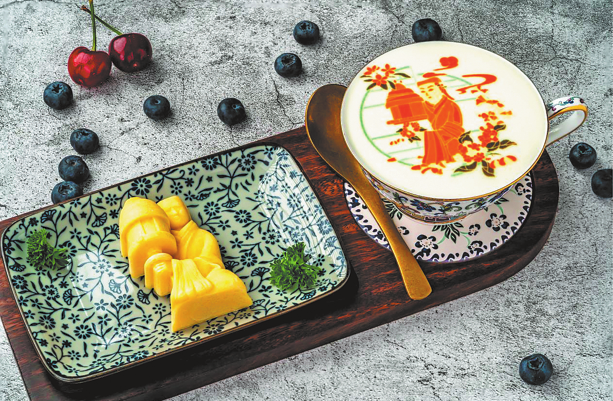
During the 2026 Spring Festival holiday season, museums nationwide are once again buzzing with excitement, with reservation slots filling up instantly and long lines of people forming at entrances.
The holiday rush has seen some visitors head straight for the star exhibits, eager to secure the best view before the galleries fill up. Others, with shopping lists in hand, are making a beeline for the museum store to pick up souvenirs as they go. Meanwhile, a growing number of people are arriving for an entirely different reason: the museum's food.
Liang, a traveler from Beijing, has kept her holiday visit to the Hebei Museum focusing on two priorities. "I come for the national treasures — and a bowl of local specialty noodles," she said, referring to the wheat noodles topped with beef, a popular regional dish.
By lunchtime, the dining and retail area in the basement of the Hebei Museum is alive with visitors.
The bowl Liang ordered has an eye-catching feature: a steamed egg, shaped like the Changxin Palace Lamp, which was placed delicately on top of the noodles. "As soon as it arrived, my eyes went straight to it," Liang said. "It's like a little lamp sitting on the noodles — it feels like tasting a piece of history."
A young visitor nearby chuckled and added, "I came for the national treasures, but I didn't expect to be fed first."
The dish takes its inspiration from a nearby exhibit. The Changxin Palace Lamp, one of the most iconic treasures of the Hebei Museum, is a gilded-bronze artifact from the Western Han Dynasty (206 BC-AD 24), over 2,000 years old. Shaped as a kneeling palace maid holding a lamp, it features an ingenious smoke-control design, with fumes drawn through a hollow sleeve and collected inside the figure. Its structure can also be dismantled into several parts, making it easy to clean the soot, showcasing both functional design and aesthetic beauty.
Li Kexin, a staff member at the Hebei Museum's art and design department, said the relic-inspired dishes were created to meet a practical need — giving visitors a place to eat after touring the galleries — while offering a more approachable way to share the stories behind the collection.
"Dining at a museum is part of the cultural experience," Li said. "We hope these dishes offer more than good flavor — that they can also serve as a more engaging way to share the stories behind our relics and heritage."