Place your trash bin by the curb at night, and by morning it is empty. The rubbish seems to have disappeared while the neighborhood was sleeping.
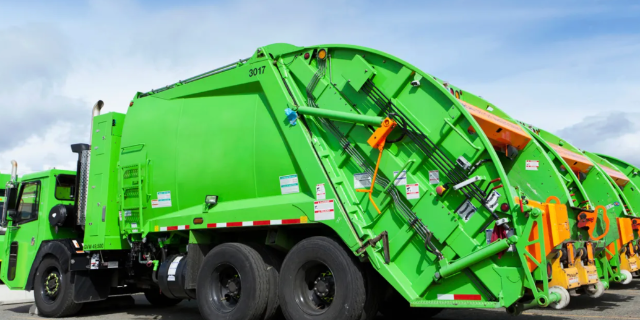
Of course, it has not vanished. Long before many people wake up, garbage trucks are already moving through the streets. And although these enormous, boxy vehicles may look simple, they are surprisingly sophisticated machines.
A garbage truck must stop every few houses, lift heavy containers hundreds of times, crush several tons of waste, and operate for hours in rain, heat, or snow. To survive that routine for years, it needs powerful hydraulic equipment, heavy-duty brakes, electronic controls, cameras, sensors, and a suspension system designed for constant stopping and starting.
So what actually happens after a garbage truck reaches your bin?
Two Ways to Pick Up the Trash
Most residential waste is collected by one of two kinds of truck: a rear-loader or a side-loader.
Rear-loaders are the traditional garbage trucks many people picture. Workers place bags in an opening at the back or use a mechanical device to lift and empty larger bins. This design has been used for nearly a century and remains practical in many neighborhoods.
Side-loaders take a more automated approach. A hydraulic arm extends from the side of the vehicle, grabs a curbside bin, lifts it above the truck, and tips its contents into an opening. It then returns the bin to almost the same spot.
On some trucks, sensors help locate the bin and guide the arm into position. On others, the driver controls the arm with a joystick. Either way, one person can often complete the entire collection without leaving the cab.
The first automated side-loader appeared in Scottsdale, Arizona, in 1969. It was nicknamed "Godzilla" — an appropriate name for a machine with a giant arm and an appetite for garbage. Later experimental models received equally colorful names, including "Son of Godzilla," "Litter Pig," and "Trash Hog."
The machines improved, and by the late 1970s, automated side-loaders were becoming increasingly common.
How a Truck Swallows So Much Trash
Lifting a bin is only the beginning. If loose rubbish simply piled up inside the truck, the vehicle would become full after covering only a small part of its route.
That is why garbage trucks contain hydraulic compactors.
Once waste falls into the truck's storage area, a powerful metal blade pushes it farther inside and crushes it. Compressing the load removes empty space between bags, boxes, and other objects, allowing the truck to carry far more material.
The truck repeats the same cycle all day: stop, lift, empty, compress, and move on.
A modern side-loader may carry roughly 12 to 14 tons of waste. Managing that much weight requires careful engineering. The vehicle must remain stable as its load grows, while its brakes and suspension endure hundreds of stops.
When the truck is finally full, it travels to a landfill, recycling center, transfer station, or waste-processing facility. There, another hydraulic component goes to work. An ejector panel — a movable metal wall inside the truck — slides backward and pushes the compacted waste out in one enormous mass.
The empty truck can then begin another route.
More Than a Giant Metal Stomach
Modern garbage trucks also carry cameras, mirrors, GPS equipment, and diagnostic systems that monitor the vehicle's condition.
Meanwhile, route-planning software helps waste companies decide where each truck should go. The system may consider traffic, the number of homes on a street, the truck's remaining capacity, the likely amount of waste, and the distance to the unloading site.
Some cities are beginning to use electric garbage trucks as well. Their lifting and compacting systems work much like those on conventional models, but batteries and electric motors replace the traditional engine.
The driver may be the only person residents see, but the operation depends on a much larger team. Dispatchers organize routes, technicians maintain the machinery, and operations staff keep the entire system moving.
Garbage collection is easy to ignore precisely because it usually works so well. Yet without these machines, waste would quickly accumulate, attracting pests and creating health hazards.
A garbage truck may not be glamorous. But hidden beneath its noisy, dirty exterior is a carefully engineered machine performing one of a city's most essential jobs.