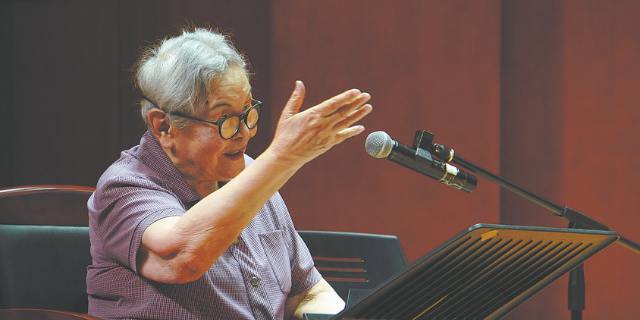
Before the curtain rose, Zheng Xiaoying would walk out and give the audience a 20-minute lesson.
She explained the music, introduced the characters and described how the drama worked. Only then would the orchestra begin playing.
This happened in Tianjin in 1982, when Zheng conducted a Chinese-language production of Verdi's La Traviata. The opera ran for 39 consecutive sold-out performances. Zheng wanted audiences to do more than hear beautiful singing — she wanted them to understand the story.
More than four decades later, she has returned to the same city with the same purpose.
Back to her "old home"
At 97, Zheng still boards flights, steps onto stages and teaches young musicians. China's first female conductor of opera and symphony recently led a two-week master class at the Tianjin Conservatory of Music.
Tianjin is not her birthplace, but she calls it her "old home". She began her formal musical education there in 1952. A few years later, she returned as one of the first teachers in the country's newly established conducting department.
Walking around the school today, she can still point out the building where that department once stood. The demanding years she spent there, she says, shaped both her career and her approach to teaching.
This time, her students included young conductors and opera singers preparing Mozart's comic opera The Marriage of Figaro.
An opera that speaks the audience's language
For Zheng, translating an opera involves more than replacing Italian words with Chinese ones. The language must also carry the characters' intentions, the humour and the conflicts beneath the plot.
The Marriage of Figaro, she reminds students, is not simply a story about a wedding. Its characters negotiate, interfere with one another's plans and challenge differences in social position. If the translation communicates only the surface action, much of the opera disappears.
Zheng has used the work in her teaching for decades. A Chinese production became a graduation performance at the Central Conservatory of Music in 1983 and later developed into a model for training young singers.
Performing in Chinese allows students to concentrate on acting and meaning while giving local audiences direct access to the story. It reflects Zheng's long-held belief that opera should not remain an impressive but distant art form.
The Tianjin master class ended with a concert performance at the city's grand theatre. For the students, the conductor in front of them represented nearly a lifetime of modern opera history.
For Zheng, the return completed a circle. She came back to the school where she first learned to conduct — not to repeat the past, but to place what she had learned into younger hands.