One hundred years ago, on June 10, 1926, architect Antoni Gaudí tragically died in a tram accident in Barcelona. In his 73 years of life, the designer left his mark on the Spanish city, from his emblematic basilica, the Sagrada Familia, to Casa Batlló, Casa Vicens, Park Güell and numerous other sites.
"Gaudí was operating within a specific time frame, where Art Nouveau was prominent around the world, but he was working in a way that transcended that," says architect Tom Gallagher, a principal at DLR Group.
The pioneering architect was born on June 25, 1852, in either Reus or Riudoms. His father was a coppersmith, and Gaudí often helped him in his workshop. In 1869, he moved to Barcelona to study architecture and, shortly after graduating, opened his own studio, developing a distinct style known for color, texture, curves and organic forms.
Nature was Gaudí's muse. "I think for Gaudí, it wasn't just important to mimic natural forms; it was also the immediate geographic vicinity and relevance that's important to his work," says Thalia Toha, a geographer and architectural historian. The front door of the Sagrada Familia, for instance, is adorned with leaves and insects, and Gaudí ensured that the basilica's pillars wouldn't be taller than the city's highest hill, Montjuïc.
Gaudí was ahead of his time in engineering his buildings using an inverted model: he would develop an upside-down physical mock-up of a structure and hang weights from a rope to see how gravity and pressure would be distributed. How the ropes fell would help determine the curvature of the arches needed to support the building. Bridge engineers today use a similar load-bearing technique. "He had structural models for paraboloids, hyperboloids, helicoids — all of those that serve as models for his structures and roofs," says Toha.
Many of his works were commissioned by prominent figures in Barcelona's textile industry. "I think that's part of his genius, that he's not only able to create these amazing things, but also able to persuade others to come along and patronize his work," says Ryan Street, owner of Ryan Street Architects.
Here are seven sites that Gaudí designed, renovated or built.
Casa Vicens (1883 – 85)
Casa Vicens, located in the neighborhood of Gracia, is the first house Gaudí designed and built. A stockbroker named Manuel Vicens i Montaner inherited the land from his mother and hired Gaudí to create a single-family home and summer residence. This 13,000-square-foot home is considered his "manifesto" — the basis for Gaudí's architectural style and where he found his voice. Gaudí used Mediterranean flora and fauna as decoration throughout. "I find it so interesting that Vicens is so different from his later works," says Toha. "In Vicens, you see the Spanish bourgeoisie influence at the bottom of the building, but then as you go farther up, it becomes increasingly more Arab and Persian." The home was turned into a museum in 2017.
Palau Güell (1886 – 88)
Gaudí's first commission for Eusebi Güell, a textile businessman and friend, was to create a mansion with both a private residence and public spaces to host events. The facade of Palau Güell is simple — a departure from Gaudí's typical highly decorative exteriors — yet the interior is lavish. "You go upstairs, and then you arrive in the center of a tall volume of space," says Gallagher. "Spatially, he's manipulating your senses so masterfully." Gallagher credits this building for continuing to shape how he thinks about movement through architecture.
Casa Calvet (1898 – 99)
Casa Calvet is considered one of Gaudí's most conservative works, built with symmetry and a traditional floor plan to fit in with Barcelona's wealthy Eixample neighborhood. It's an early work with a simple Baroque style, but the attention to detail marks it as unmistakably Gaudí's. He included references to the owner's textile business, such as columns shaped like bobbins.
Park Güell (1900 – 14)
Tourists visiting Park Güell — a 47-acre complex of architectural elements and gardens — often photograph its serpentine mosaic bench and the salamander at the park's entrance. The original plan was intended as an estate for wealthy families. "The master plan was to have 62 housing plots, a marketplace, a public square, a street system — he went big on a utopian ideal of what city planning needs to be," says Toha. By 1914 the project was abandoned, and the park opened in 1926. It was designated a UNESCO World Heritage Site in 1984.
La Torre Bellesguard (1900 – 09)
The Tower of Bellesguard is built on land containing remnants of a medieval castle. It stands out for leaning into Gothic architecture — unusual for Gaudí — yet still carries his signature iconography. "It has these anthropomorphic elements that look like nature, or literally a beast — in this case, a dragon, which is heavy with symbolism for local culture," says Street.
Casa Batlló (1904 – 06)
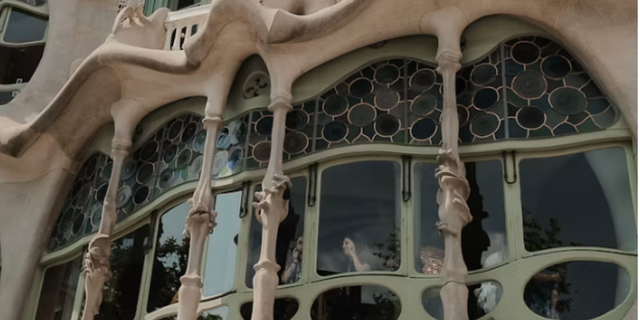
Casa Batlló features a whimsical, colorful mosaic facade with undulating metal balconies and multi-hued tiles on the roof. The shimmering tiles are thought to represent the scales of a dragon. "The tiles were intended to be similar to the reflections of bubbly light on the surface of the Mediterranean," says Gallagher. Casa Batlló is also known as the "House of Bones" — the balconies allude to skulls without being literal.
La Sagrada Familia (1882 – Present)
The Sagrada Familia is by far Gaudí's most famous work. He took over the plans in 1883 at age 31 and transformed it into the vision we see today. "There was such a commitment, and he knew it was never going to be done in his lifetime," says Gallagher. In early 2026, the basilica's central tower was completed. Gaudí sculpted life-size human figures modeled after people he knew. In the nativity scene above the entrance, the models were family members of the construction workers. "These are average workers, and they get immortalized into the highest level of reverence in the Sagrada Familia," says Toha.