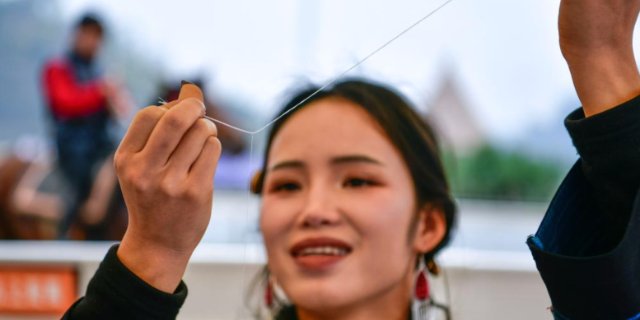
Horse tail embroidery is one of the most distinctive textile arts of the Shui people, a small ethnic group living in the mountainous regions of Guizhou Province. What sets it apart is its unusual thread: thin strands of horse tail hair are wrapped tightly with fine silk yarns, creating a firm yet lustrous thread unlike anything found in mainstream embroidery traditions. The process of preparing these threads alone requires patience and precision — each strand must be carefully selected, aligned, and wound by hand before a single stitch is made. The finished works are intricate and durable, recognized as a national intangible cultural heritage for the exceptional skill they demand.
The craft has deep roots in Sandu, a county in Guizhou where the Shui community has long preserved this tradition through generations of female practitioners. Mothers teach daughters, and the techniques — from preparing the horse tail threads to laying complex geometric patterns — are passed down as part of everyday life. Traditionally, horse tail embroidery adorned festive garments and ceremonial accessories, its bold patterns carrying meanings tied to Shui cosmology and community identity. A single piece could take months to complete, making each work a quiet act of devotion as much as a display of skill.
In recent years, horse tail embroidery has found a new audience. Local artisans have begun incorporating the traditional motifs into modern products: embroidered handbags, decorative panels, and accessories that appeal to buyers far beyond the village. Some embroiderers have taken to livestreaming their craft, stitching in real time while viewers watch and shop online. What was once made exclusively for special occasions is now traveling — tucked into tote bags, hanging from keychains, framed on city apartment walls.
Competitions and exhibitions have also helped bring younger practitioners into the fold, creating spaces where embroiderers can showcase their skills, exchange techniques, and take pride in a craft that connects them to something larger than themselves. For many, learning horse tail embroidery is not just about mastering a technique — it is about belonging to a lineage. The ancient art, once at risk of fading quietly into memory, is now being carried forward, one careful stitch at a time.