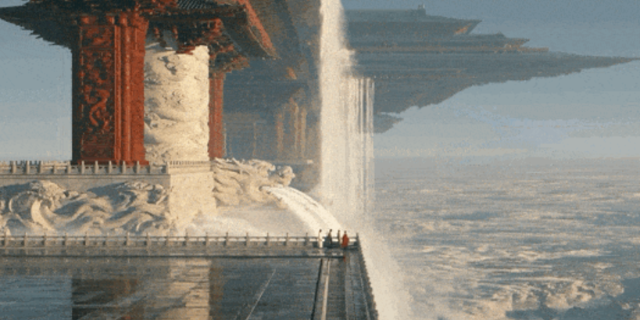
"This is the immortal world I imagined!"
The video lasts only 34 seconds. Clouds run to the skyline. A wide stone stairway climbs toward palaces with curved roofs, hanging above the mist. Immortals drift past in long robes. Nobody speaks. There is no plot to follow. Still, people watch it again and again, then type the same kind of line: this is the heaven they had only pictured in their minds.
So what does heaven look like in the Chinese imagination?
It is not a gate of gold or a choir of angels. It is tianting — the celestial court of Chinese myth. Gods live in halls above the clouds. A long climb stands between ordinary people and that high world. An AI video has now put that old picture on a screen, close enough to feel real.
The maker is Qi Guang, known online as Qiguang (栖光). He runs an eyeglasses shop and builds AI videos in his spare time. The clip spread fast, pulling in millions of views and thousands of comments. Foreign viewers filled the thread with shock, jokes, and memes.
Qi Guang thinks the pull is the mood. The pictures leave a lot of space: sky, mist, and quiet. The look is simple, and also large. He says every fan of xianxia — Chinese fantasy tales about immortals among clouds and cliffs — already has a private version of that world. The video is one version that other people can finally see.
Overseas viewers asked most about the stairs. Qi Guang had put them in on purpose. "The staircases symbolize the distance between the mortal world and the world of immortals," he said. "They are the crossing from human life into the heavens." You can find the same idea in old myths, tales of ghosts and wonders, and landscape paintings.
He works alone. From first still images to a set of "Chinese Heaven" videos, the job usually takes about five hours.
People argue a lot now about AIGC, or AI-generated content. Qi Guang's view is plain. AI is a tool, not the work itself. Tech should serve what a person wants to say. Use it well, he argues, and you still have to hold the core. Humans lead.
In his own process, AI can take the heavy lifting: building scenes, trying new frames, turning a sketch into a finished shot. It should not take over the thinking — how the world is built, which old stories to keep, how a figure on screen should feel. That matters most with traditional culture, myth, and xianxia. Those subjects need reading first, and a careful hand on whether the culture is shown right.
The clip did not appear alone. The "Chinese Heaven" look, the White Rabbit candy-wrapper style, and overseas phrases such as China Travel, Chinamaxxing, and Becoming Chinese have all caught fire. Old Chinese images, it seems, can still stop a scrolling thumb.