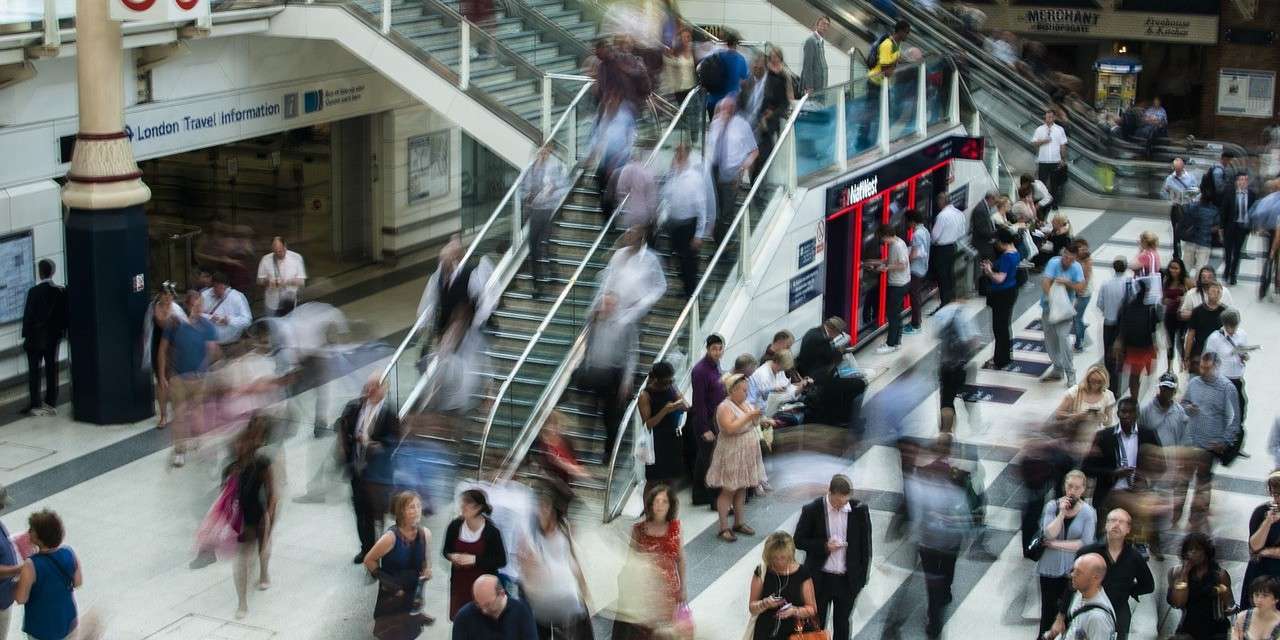
Step off a train at a busy station and, for the next few seconds, you are not really making a decision. The platform noise closes in, the exit is somewhere ahead, your legs are already moving, and your eyes settle on the one thing that seems to know where it is going: the back of a stranger's head.
At Eindhoven Centraal in the Netherlands, that moment has been recorded a staggering number of times. An overhead tracking system logged more than 30 million pedestrian trajectories there between March 2021 and March 2024, everyone stepping off the trains and everyone already waiting on the platform. The sensors read depth rather than faces, so they never record identifiable images of pedestrians; a commuter is just a moving shape. Three years of those shapes turned out to expose a habit almost nobody notices in themselves.
In crowded places such as streets, stations and airports, we assume we are picking the fastest way out. Our route is shaped by walls, doors, stairs, kiosks, corridors and bottlenecks, and by how congested a stretch of floor looks. We judge by how long a path feels rather than how long it is, because a shorter route is no bargain if it is packed. And in a crowd we adjust our speed and direction constantly to the people around us, drifting into whatever flow is moving, because other bodies are free information about where a usable path might be.
On the platform at Eindhoven, a kiosk stands in the middle of the walkway. Getting off a train near it hands you a tiny, forgettable choice: cut straight toward the exit, or swing the long way around. About 100,000 passengers leaving from three particular door zones faced exactly that fork.
Friends and families were stripped out of the count first. People who walk shoulder to shoulder, match each other's pace and turn the same way are traveling as a unit, and their choices say nothing about strangers. What remains is a crowd of people who have never met.
They copy each other anyway. Passenger after passenger takes the same path as whoever stepped off just ahead of them, with no connection between them, no word exchanged and no idea who that person is. The copying holds even when the followed route is the slower one, and the imitator loses time going around the kiosk for no reason at all.
One copied choice then becomes the next person's cue. The result is an "avalanche" of choices, a run of people making identical decisions in succession, until a whole stream of commuters is funneled the same way by a call the first of them made without thinking.
It is tempting to explain this away. Perhaps walking speeds are simply random and the pattern is an illusion. Perhaps everyone is following the majority, the way crowds are supposed to behave. Neither holds up. Simulations of that platform only reproduce what actually happens on it once the pull of the single person in front is written in. What steers the crowd is not the crowd. It is one stranger, one step ahead.
Which makes a train station exit a small demonstration of something much larger. Brief, wordless, barely conscious exchanges between strangers scale up into the movement of thousands, with real consequences for how crowds are managed and how public spaces are designed. So the next time you stride off a platform certain you know the way out, glance at the person in front of you. There is a decent chance they do not know either.