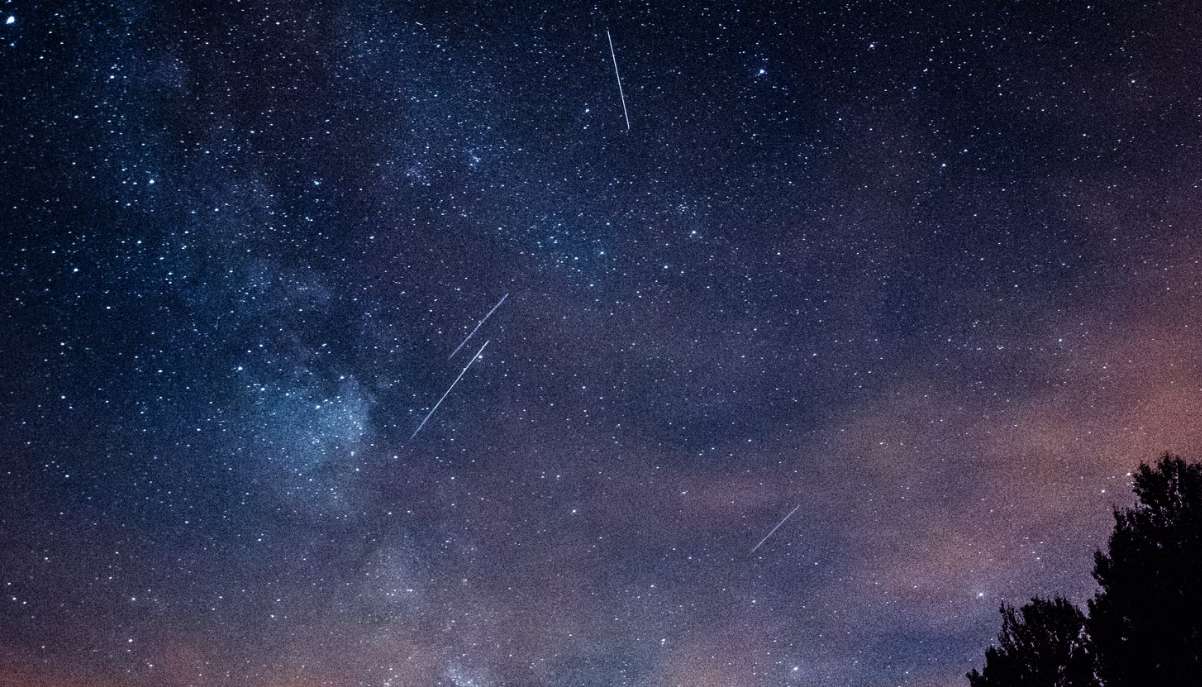
Summer usually means less darkness for stargazing, but July bucks the trend with a smorgasbord of meteor showers. Venus is also putting on a show, and there's a rare chance to spot distant Pluto through a telescope. Tropical skywatchers can also catch the strange phenomenon of Lāhainā Noon again this year.
July 8 and 9: Venus Near Regulus
Venus is prominent throughout July, moving toward its point of full elongation — its greatest distance from the sun in the sky — which it reaches in August. The nights of July 8 and 9 are especially good for viewing, per the Farmer's Almanac: Venus will sit right beside Regulus, the brightest star in Leo, in the western sky just after sunset.
July 10: July Pegasids Predicted Peak
The July Pegasids aren't the most spectacular shower, but this will be a good year to see them, since the moon will be a mere sliver at their peak. The radiant point — where the meteors appear to emerge — is in the constellation Pegasus, which rises in the east not long after sunset. Best viewing comes after midnight.
July 11: Lāhainā Noon Begins
If you're in Hawai'i or elsewhere in the tropics, July 11 brings the second of 2026's two Lāhainā Noons, when the sun sits directly overhead and objects cast no shadow at all. The exact time depends on your location; the Bishop Museum provides a chart of times for various parts of Hawai'i.
July 27: Pluto at Opposition
This month the Kuiper Belt's most famous resident reaches full opposition, sitting directly between Earth and the sun — meaning Pluto will be as brightly lit as it ever gets. You won't spot it with the naked eye, though. You'll need a decent telescope, ideally at least a 10-inch instrument, and a location well away from city light pollution.
July 28: Gamma Draconids Predicted Peak
Unlike the Pegasids, the Gamma Draconids collide with an almost full moon this year, making them harder to see. That's a shame, since a decade ago this shower produced a surprise outburst of up to 40 meteors an hour, far above its usual rate of about five. This month the shower returns to the same position it held during the 2016 outburst, so there's still a chance. Look toward the constellation Draco in the northern sky; the moon sets around 5 a.m. local time, leaving a brief window of darkness before sunrise.
July 29: Full Buck Moon
This month's full moon is called the Buck Moon, named for the fact that male deer's antlers are in full-growth mode at this time of year. It reaches peak illumination at 10:36 a.m. EDT on July 29, then begins to wane, making way for August's meteor showers.
July 30: Delta Aquariids Predicted Peak
The Delta Aquariids are an underrated shower best seen from southern latitudes, and like the Gamma Draconids, this year's full moon will make viewing difficult but not impossible. The shower is long-lived, starting in mid-July and continuing into August, where it overlaps with the Perseids — so you might have better luck viewing before or after the predicted peak, when the moon is less of a problem. Look for meteors in the southern sky just above the star Fomalhaut, near the square formed by four stars in Pegasus.
For the best view of any of these events, get away from light pollution and give your eyes time to adjust to the darkness before heading out.