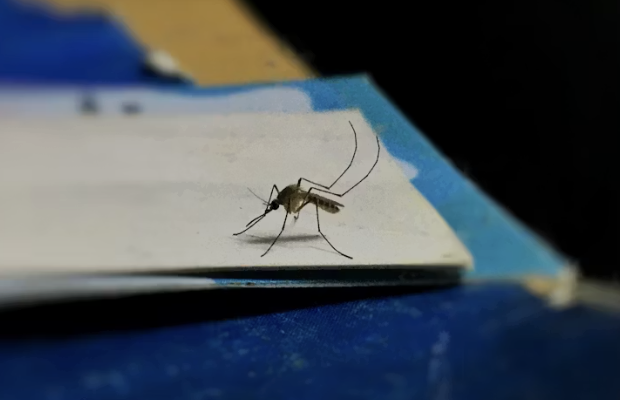
It is a spray used worldwide to protect humans from mosquito bites, but now research suggests Deet can become attractive to the insects if they associate it with feeding.
Deet — which has the chemical name N,N-diethyl-meta-toluamide — is widely used in insect repellants. Such protection is important given that in some countries mosquito bites can spread fatal diseases such as dengue, Japanese encephalitis, malaria and Zika.
However, a new study suggests that, as Pavlov's dogs learned to associate the ringing of a bell with food, so mosquitoes can learn that the presence of Deet indicates the possibility of a blood meal.
"For a long time, it was believed that repellants worked solely because of their chemical properties, either by being toxic or unpleasant to mosquitoes and driving them away, or by blocking their ability to detect humans. However, our findings suggest that the reaction can be modified by experience," said Prof Claudio Lazzari, from the University of Tours, France. "We believe this represents a significant change in our understanding of repellants."
Writing in the Journal of Experimental Biology, the researchers said they initially observed how trapped mosquitoes attempted to bite a bag of warm blood that they could not quite reach.
Further investigation revealed that 60% of mosquitoes that fed when presented with warm blood alongside exposure to Deet subsequently showed biting attempts when exposed to Deet alone — compared with around 17% of untrained mosquitoes.
In another test, almost 60% of mosquitoes that previously fed on blood while exposed to Deet subsequently attempted to bite a researcher's Deet-treated hand. By contrast, untrained mosquitoes universally tried to bite the researcher's other, untreated hand.
Dr Nina Stanczyk of ETH Zürich, who has previously studied the effectiveness of Deet, welcomed the research. "Mosquitoes have been shown to have impressive learning abilities, but the fact they can associate such a strong repellent smell with their food and are then attracted to it afterwards is remarkable," she said.
However, experts emphasised that the findings did not mean that travellers should ditch their Deet.
"People should understand that Deet does not lose its effectiveness through normal use, but only under specific laboratory conditions designed to reveal how it works on mosquitoes," said Lazzari.
Prof Francesca Romana Dani, an entomologist at the University of Florence, said it was unlikely that, under normal conditions, mosquitoes would change their response to Deet based on previous experience — not least as the same insect may encounter different repellants during subsequent blood meals.
"Furthermore, although a single mosquito can take multiple blood meals, they do so every few days, so it's important to evaluate how long the memory of a blood meal taken in the presence of Deet will last," she said.
Stanczyk said travellers should continue wearing repellants with confidence. "The most important point for travellers is to regularly reapply repellant as instructed by the product label," she said.