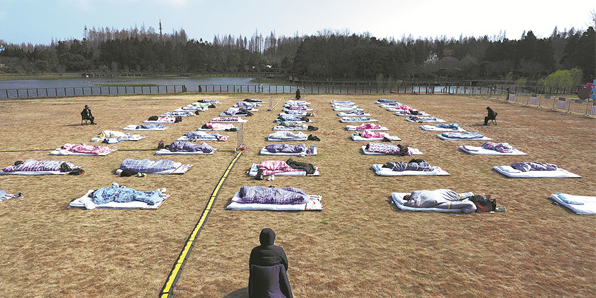
Rong Weiqing, a 35-year-old studio owner from Shanghai's Songjiang district, recently enjoyed a luxurious two-hour afternoon nap in a distant forest on the city's Chongming Island.
Driving over two hours to the island, she was one of 43 participants to take part in the sleep-in-forest competition, which kicked off on World Sleep Day in Dongping National Forest Park. Immersed in sunshine, fresh air and greenery, contestants gathered for a good sleep and the chance for a cash prize.
Starting March 21, the competition takes place every Saturday through April 26, as well as on May 2 and 3. Professional sleep monitoring devices are set up on site to objectively collect, record, and evaluate competitors' sleep conditions and quality through data metrics, including sleep latency, total sleep duration, deep sleep duration, and sleep continuity.
"We detect competitors' subtle body vibrations from the heart, lungs and other organs. When they go into deep sleep, the heart rate slows down and heart activity decreases," explains Xu Wei, technical director of AnLight Optoelectronic Technology Co.
Falling asleep is not mandatory for the competition. Participants are allowed restful activities such as simply closing their eyes or lying still. Throughout the entire event, participants remain lying down on the provided mattress. Electronic devices, such as cellphones, tablets, and other entertainment devices, are not allowed.
At every competitive event, the participant with the highest sleep score can win a cash prize of 3,000 yuan ($435), while the contestant who falls asleep the fastest can earn 2,000 yuan. All other participants who follow the rules and reach the end share a prize pool of 10,000 yuan, according to the organizers.
The competition has seen strong registration numbers and increased popularity on social media. All 400 spots in eight events were filled within three days, with participants aged 18 to 30 accounting for 54.1 percent, says Chen Haixing, chairman of the Shanghai Chongming Ecotourism Group Co.
"Sleep is essential, yet it is becoming a major challenge for urban dwellers. Chongming has long been committed to building a world-class ecological island and has already achieved significant results. With the competition, we aim to raise public awareness about healthy sleep, helping them reconnect with nature and find inner peace," Chen adds.
With the rapid development of modern society, sleep quality remains a pressing problem for many. The China Sleep Research Society recently reported that nearly 500 million adults in China suffered from sleep disorders in 2025. Staying up late, irregular sleep schedules, emotional stress, and dependence on electronic devices are among the main factors affecting the sleep quality of young people.