Fashion is often defined by global runways, luxury houses and seasonal trends. But in the mountains of Southwest China's Guizhou province, a different vision is taking shape — one rooted not in exclusivity, but in craftsmanship and community.
For designer Yang Chunlin, better known online as Gu Axin, fashion is something that grows out of local ethnic culture.
That belief sits at the heart of "Village T", or "Village Runway", a grassroots fashion initiative Yang launched in 2024.
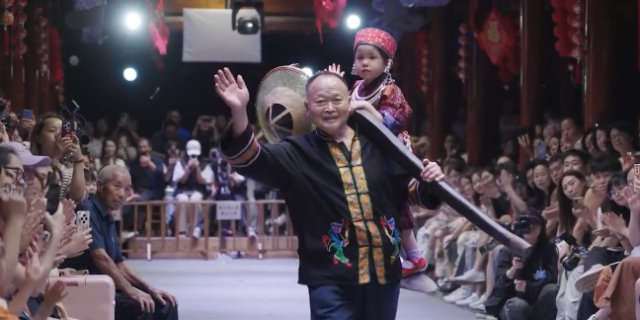
It began as a small, improvised runway in an open field, where a ridge of farmland became the catwalk and villagers stepped naturally into the role of models.
"There were no resources, no team, no experience, and many voices of doubt," Yang said, recalling the early days.
He said many locals initially believed fashion had nothing to do with them. "People in the mountains have rich culture and craftsmanship, but we often lack confidence and underestimate what we're capable of," he added.
For Yang, that perception gap was precisely why the project mattered — to create a stage for people from his hometown to be seen on their own terms.
What followed was not a conventional fashion production, but a collective act of creation. Elders, embroiderers and young villagers all contributed what they could — clothing, labor, and traditional craft knowledge — turning the early shows into a shared expression rather than a rehearsed presentation.
"There are no professional models, scripts, or staged performances," Yang said. For him, that is where the magic lies: its authenticity.
As "Village T" grew, it became a platform for showcasing Guizhou's intangible cultural heritage, particularly Miao embroidery.
Miao embroidery, known for its freehand technique and rich symbolism, is often described as a form of visual storytelling. Its patterns carry ancestral memory, mythology and identity.
Among the garments featured in the show, one piece holds special meaning for Yang: a Miao embroidered jacket transformed from a traditional "hundred-bird coat", a ceremonial Miao garment. But Yang's decision to reshape it into a modern silhouette sparked local debate.
"Many people didn't understand and felt distressed, saying I was destroying an antique," he recalled.
For him, however, the transformation was never about erasing tradition, but about extending its life. "In its modern design, the new jacket fully retained all the hand embroidery and cultural totems of the original garment," Yang explained.
More broadly, his philosophy is that heritage must evolve to survive. Traditional craft, he argues, should not remain frozen in museums or confined to ceremonial contexts, but should continue to live through contemporary expression.
A changing village
Today, "Village T" has become more than a fashion showcase. It has reshaped local life.
"More and more young people are willing to return home to start businesses, and the works of senior embroiderers have found new markets and increased in value," said Yang.
Tourism has grown, and traditional craftsmanship has regained cultural relevance. But perhaps its most lasting impact is less visible: a shift in how younger generations see themselves.