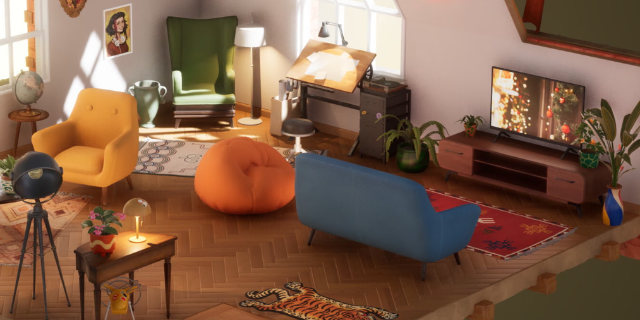
No monsters are chasing you. No clock is counting down. Nobody expects you to save the world.
Your only job is to plant carrots, arrange a bookshelf and decide whether the virtual sofa looks better beside the window.
This is the promise of "cozy content" — games, shows, books and videos designed to make audiences feel safe. Instead of danger and conflict, they offer quiet routines, friendly characters and small problems with satisfying solutions.
For many young adults, that is exactly the point.
Entertainment as a warm blanket
Popular entertainment often holds our attention by raising the stakes: a hero is in danger, a relationship is collapsing or a secret is about to be revealed.
Cozy content moves in the opposite direction. A video may show someone cooking for friends. A game might ask players to grow vegetables, care for animals or decorate a room. The pleasure comes from knowing that nothing awful is waiting around the corner.
A survey cited by the Los Angeles Times found that 58% of American adults aged 18 to 30 thought stories about young people had become too dark. More than 70% wanted lighter, more joyful programmes featuring people their age.
They are not rejecting serious stories forever. Sometimes they simply want entertainment that does not feel like another problem to manage.
A world that follows the rules
Cozy games replace competition with creation and uncertainty with predictable routines.
Plant a seed and it grows. Finish a task and receive a reward. Paint a wall and the room immediately looks better. Progress is visible, and mistakes are rarely permanent.
Real life does not always work this way. Effort may go unnoticed, plans can fail and important goals take years. In a cozy game, twenty minutes of work can produce a beautiful garden or an organized home.
Many newer games focus on cleaning, furnishing and restoring virtual spaces. There is an obvious irony: some players who cannot afford much living space may spend hours choosing wallpaper for a large digital house. But decorating it offers something reality often withholds — complete control.
Small tasks, complete endings
Cozy content turns ordinary activities into miniature success stories. A dirty room becomes clean. An empty field becomes a farm. A collection of ingredients becomes dinner.
This can feel deeply satisfying when life is filled with unanswered messages, uncertain plans and distant goals. It also makes rest easier to accept: arranging digital furniture still looks like activity, even when the real purpose is relaxation.
A gentle game cannot solve financial pressure or loneliness. But entertainment does not always need to solve a problem. Sometimes its job is simply to give the mind somewhere quiet to sit.
The carrots will grow. The sofa will fit. And for once, everything will probably be fine.