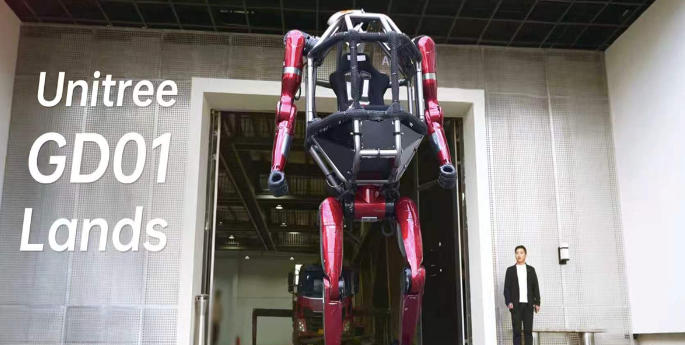
For years, the idea of humans piloting towering, bipedal mechas was purely the stuff of sci-fi blockbusters like Pacific Rim. But the boundary between sci-fi imagination and real-world engineering is rapidly blurring in China.
In a scene straight out of a futuristic trailer, Unitree Robotics CEO Wang Xingxing strapped into the GD01, a roughly 2.7-meter-tall machine touted as the world's first production-ready manned mecha. Piloting from within, Wang maneuvered the heavy-duty machine forward, deploying its mechanical arms to smash through walls with ease. Unveiled last Tuesday, the transformable mecha is priced from 3.9 million yuan ($650,000). The machine's debut immediately went viral on both Chinese and foreign social media, captivating netizens who hailed the engineering breakthrough as the exact moment where "science fiction becomes reality."
Lukas Ziegler, a prominent robotics evangelist in Europe, shared a demo video showcasing the operation of the GD01 mecha in a post last Tuesday. "Chinese companies accounted for nearly 90% of global humanoid robot sales in 2025. Unitree alone shipped 5,500+ humanoid robots last year… The West is building incredible humanoid robots. China is building them faster, cheaper and at a scale nobody else is close to matching."
Billed as the world's first production ready manned mecha, the GD01 can transform, operate as a civilian vehicle, and weighs about 500 kg with a person inside. Regarding the 3.9-million-yuan price tag and mass production plans, Huang Jiawei, a marketing staff member at Unitree Robotics, told the Global Times last Tuesday that the figure is only a preliminary reference price. "The final production version may still be adjusted depending on performance optimization," Huang said. He added that the mecha is a special model and, while the company has the capability for large-scale production, further functional optimization and cost reduction will still take time following the product's initial launch. "The application scenarios for Unitree's products are mainly aimed at changing the way we work. For example, our robots can be used in high-risk and harsh environments," Huang told the Global Times.
Chen Jing, vice president of the Technology and Strategy Research Institute, told the Global Times last Tuesday that the GD01 shows China has crossed a key "engineering threshold" in embodied AI. "It is no longer just a proof-of-concept machine confined to laboratories, but a product with a clear price tag and commercialization roadmap," Chen told the Global Times. Although still distant from mass adoption, these machines could eventually carve out roles in diverse fields, veteran technology analyst Ma Jihua told the Global Times, pointing to potential uses in theme parks, immersive entertainment, filmmaking, rescue efforts and operations in challenging environments.
The buzz surrounding Unitree's GD01 is far from an isolated moment. Over the past year, humanoid robots and embodied AI have steadily captured the public imagination. Wang Peng, an associate research fellow at the Beijing Academy of Social Sciences, told the Global Times last Tuesday that Unitree's mecha represents "a concentrated breakthrough built on years of industrial-chain accumulation." Wang said Unitree's ability to rapidly launch such products is backed by China's highly dense and responsive manufacturing ecosystem. From high-performance motors and batteries to carbon-fiber materials, China's mature supply-chain network allows companies to quickly source components, accelerate product iteration and reduce development costs. "Such ecosystem advantages will be difficult for overseas manufacturers to replicate in the short term," he said.