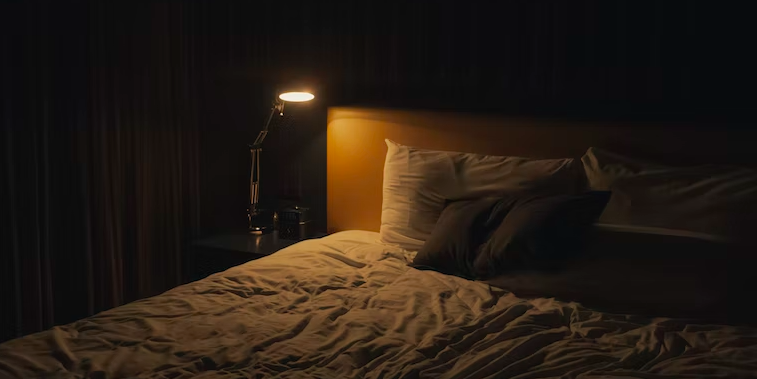
It's 2 a.m., and you've been awake for an hour — staring at the same patch of ceiling and doing increasingly alarming math about how wrecked you're going to feel tomorrow. Your instinct is to stay right where you are and try harder. And even if sleep doesn't come, at least you're resting — right?
Not exactly. The better move, sleep researchers say, is the one that feels most counterintuitive: Get up, leave the room, and do something else. It's an old idea — people who study sleep were suggesting it back in the 1970s, and it has been passed along ever since.
The problem begins when you treat sleep like a task you need to accomplish. "Effort is the enemy of sleep," says Shelby Harris, a sleep researcher. People who sleep well, she points out, aren't using some secret trick. "They don't really do anything," she says. "They just fall asleep."
Sleep isn't something you can will into happening, says Michael Perlis, a sleep researcher at the University of Pennsylvania. And the idea that lying there is at least restful? Perlis rejects that, too. "If rest was any good," he says, "we wouldn't sleep."
So how long should you stay in bed? People are often told to get up after about 20 minutes awake. But many researchers have moved away from that rigid cutoff: you can't time 20 minutes without looking at a clock, and clock-watching at night is a reliable way to get even more stressed about not sleeping.
Instead, notice your mood. The signal is frustration — your mind is racing, you're getting annoyed, or you catch yourself trying to force sleep. "That's the sign that's usually around 20-ish minutes," Harris says. "Get out of bed, go do something else just to pass the time, and only go back to bed when you think you might be sleepy again."
Perlis sums up his advice in a simple slogan: "Give up. Get up. Get out." Sitting up, standing, and walking send powerful signals to the body to be awake. When you stay in bed trying, he says, you can end up "surfing," flickering between wakefulness and sleep without ever feeling as though you slept at all. "You get nothing from surfing," he says.
Becoming fully awake interrupts that pattern and lets sleep pressure — the biological drive that makes you sleepy — build. Even if getting up doesn't rescue this particular night, it can improve your odds of sleeping better the next one. Leaving the bedroom also preserves the link between your bed and sleep: the more time you spend there tossing, turning, and worrying, the more your brain associates bed with wakefulness.
Whatever you do once you're out of bed, the goal shouldn't be to do something tiring, Harris says. So pick something you actually enjoy. "I collect cookbooks — old cookbooks — and I look through my old cookbook collection," she says. "I go to my kitchen and then I earmark old family recipes." She has also seen people take up art projects and knit what she affectionately calls "insomnia scarves."
It also shouldn't feel like punishment. Harris recalls a colleague who told people to go sit in their "insomnia chair" — and now they "dread that chair because they associate it with wakefulness."
A few ground rules help. Don't turn 3 a.m. into bonus productivity time. "Don't do your work. Don't do taxes. Don't do bills," Harris says. "The more you wake up and do work, the more you're teaching your body to have those awakenings." You don't need to keep the room dark, either — turn on a lamp. And don't fall asleep on the couch, or you'll train yourself to sleep there and dread your own bed.
Plan ahead, too. "You have to think about all the excuses you're going to come up with at night," Harris says. "Think about it during the day, and problem-solve for those." If your home is cold, "keep a robe and slippers right next to your bed," she says.
Once you feel sleepy again — and perhaps notice yourself yawning — return to bed. "See what happens," Harris says. If your mind starts racing again, "get back out, rinse, and repeat."
And the next time you're lying awake at 2 a.m., furious that sleep hasn't arrived, remember: the wakefulness isn't necessarily the biggest problem. Your reaction to it might be. "Change the narrative," Harris says. "Trying to force it is only going to make it worse."