When we hear certain sounds, our brains often pair them with specific shapes. For example, most people will associate a sharp-sounding word with a jagged, pointed shape, while a soft, rolling word is linked to something smooth and curved. This fascinating phenomenon is known as the bouba-kiki effect.
The name comes from a classic psychology experiment where people are shown two drawings: one is rounded and bulbous and the other is sharp and spiky. When asked which shape is bouba and which is kiki (both invented words that have no actual meaning), the majority of people choose the round shape for bouba and the spiky one for kiki.
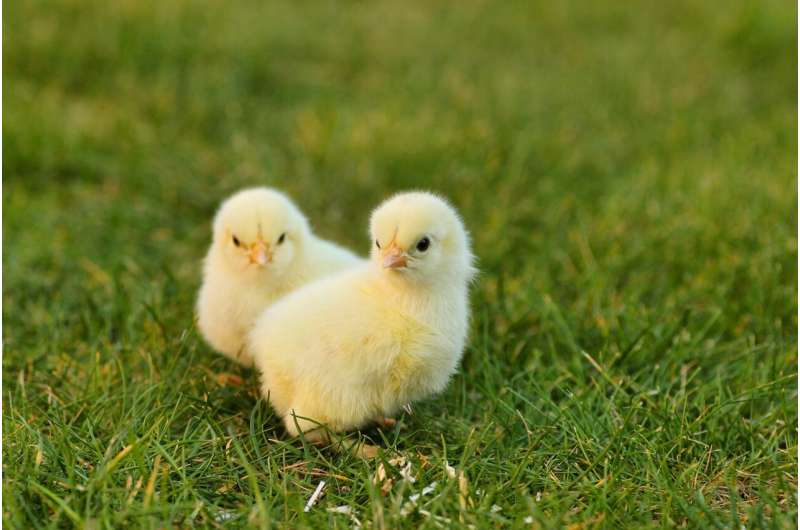
For a long time, scientists have debated whether this is an association we learn as we grow up and begin to speak. However, a recent paper published in the journal Science showed that baby chicks can also spontaneously match these sounds to shapes. It suggests that the ability may be at least partly innate rather than a learned human skill.
Matching sounds to shapes
Researchers from the University of Padova in Italy trained three-day-old chicks to find a food reward behind a panel that had a drawing of a neutral shape (half-spiky, half-round) on it.
They later showed the chicks two new panels at the same time, one with a round shape and one with a spiky shape. At the same time, speakers repeatedly played either bouba or kiki. When they heard the kiki sound, the chicks consistently moved toward the spiky shape and, on hearing the bouba sound, headed toward the round one. And they did all this even though they had never been trained to link the sounds to shapes.
The team then repeated the experiment with chicks that were less than a day old, although this time without any training or rewards. As in the first experiment, they explored the spiky shape when hearing kiki and a round shape when hearing bouba.
The researchers chose chicks as their experimental model because they are precocial. This means they are relatively mature and mobile not long after hatching, and have had limited opportunities to learn sound and shape associations from the outside world.
Innate ability
The team believes that because birds and mammals are distantly related (sharing a common ancestor around 300 million years ago), the bouba-kiki effect is not just a quirk of our language. Instead, it could be an ancient organizing principle of the brain that helps animals navigate the world, as the team notes in their paper: "Our data place the origin of sound-shape crossmodal matching [the ability of the brain to link information from different senses] at the earliest stages of life, possibly hinting at a predisposed experience-independent mechanism."
The scientists suggest that because they found this in chicks, future studies should examine other species to determine how widespread the bouba-kiki effect may be.