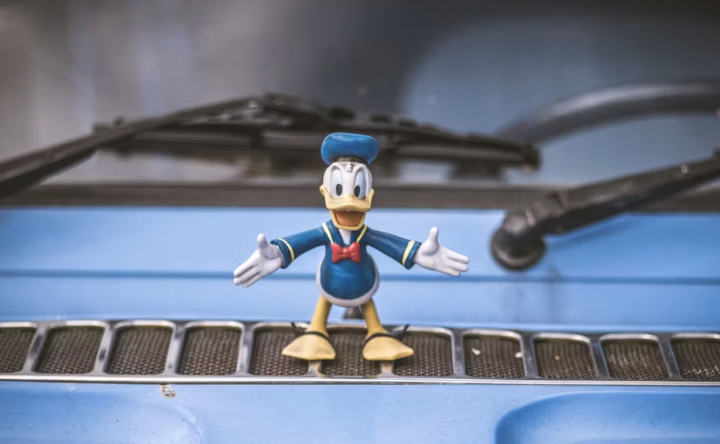
Donald Duck made his cartoon debut in "The Wise Little Hen" back in the summer of 1934. But he wouldn't meet Mickey Mouse until his second appearance in "Orphan's Benefit" later that year. From there, it wasn't long before Daisy Duck and his nephews Huey, Dewey, and Louie were introduced. In spite of their superior diction, they weren't able to steal the spotlight from Donald. You can't replace his grumpy, nearly incomprehensible charm — and it's why Donald has been in more movies (200+) than any other Disney character.
His accomplishments don't stop there. He co-hosted the Oscars in 1958 with a little help from Bob Hope, Jack Lemmon, and Jimmy Stewart. An asteroid was named after him in 1995. And he has a star on the Hollywood Walk of Fame. We're not sure how he left webbed footprints in front of the Chinese Theater, but we'll gladly roll with it.
A brief history of Donald Duck
The world was introduced to Donald Duck on June 9, 1934. More or less starting off as a comic-book character, he remains the most published non-superhero ever. Such is his popularity that Donald Duck is a national hero in Finland — a pop culture icon much like Hello Kitty is in Japan. Donning his signature blue sailor suit with no pants, Donald has appeared in more short films and feature films than any other Disney character, taking on roles ranging from army officer and teacher to devoted uncle of three ducklings.
Walt Disney conjured up the idea for Donald to introduce an edgier character to balance out the relentlessly cheerful Mickey Mouse. During the experimental phase of Donald's creation, Disney reportedly drew inspiration from Australian cricketer Donald Bradman, who had made headlines after being dismissed for a duck.
Another defining feature is Donald's voice. Clarence Nash, the original voice actor, created a distinct sound through "buccal speech" — a form of vocalization that uses the inner cheek rather than the larynx. Nash first discovered the technique while trying to mimic his pet goat.
In the 1940s, Donald overtook Mickey Mouse with over 128 independent short animations, soaring to popularity faster than any other Disney figure. Disney produced a series of short films featuring Donald Duck, one of which earned the studio an Academy Award for Best Short Film.
Beyond the screen, Donald got his own comic in the 1940s that branched into an entire series, still enjoyed by adults and children today. The Donald of the comics — who lives in the town of Duckburg and dotes on nephews Huey, Dewey, and Louie — is notably more mild-mannered, with better-articulated speech and emotions than his animated counterpart.
After Walt Disney's death, Donald did not appear on screen again until 1983. He continues to be a legend today, featured in films, television shows, and comics alike. What makes Donald so endlessly relatable is simple: he is always getting into trouble, and always having to get himself out using nothing but his wits and whatever slim resources he has on hand.