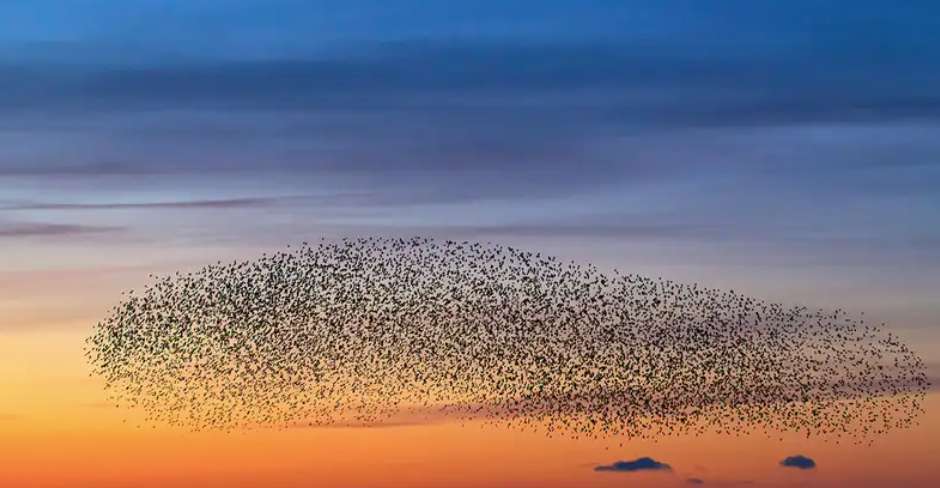
Birds can see much of the world around them, but in one model of flocking, they adjust their direction mainly in response to birds ahead of them or beside them. Imagine two birds flying one behind the other. The bird at the back changes course when the bird in front turns. The leading bird may carry on without reacting to the bird behind it. This simple example poses a problem for physicists trying to describe how an entire flock moves.
The problem becomes clearer if we look at Newton's third law. When we run, our feet push against the ground, and the ground pushes back with an equal force in the opposite direction. The same principle helps explain how a boat moves when we row or why a balloon shoots forward when air escapes from it. In each case, the physical forces come in pairs.
A model of flocking describes which birds adjust their movements in response to which neighbors. In that model, one bird can influence another without receiving a matching response. Physicists call this a non-reciprocal interaction. The one-way influence describes the birds' behavior. Newton's third law still governs the physical forces involved in their flight.
Similar patterns can appear in bacterial swarms, crowds of people, and even groups of cells in living tissue. Individuals respond to some of the things around them, and those responses need not be mutual. Many familiar tools in physics are designed for systems with reciprocal interactions, in which the influence goes both ways. That makes them hard to apply directly to models like the one for bird flocks.
Giving Each Bird an Imaginary Partner
In a study published in Nature Physics, researchers including physicists Ricard Alert, Marin Bukov, and Roderich Moessner developed a mathematical way to bring these familiar tools to bear on one-way interactions. The idea is to give each component of a system an imaginary partner.
Physicists describe a moving system using variables that stand for real properties, such as a bird's position and speed or a car's position in traffic. In the new framework, each component also gets an extra variable that exists only in the equations. For a flock, Alert illustrates the idea by picturing a fictitious bird in front of each real bird, facing the opposite direction.
The researchers set up reciprocal interactions in this larger model, which contains both real birds and their imaginary partners. They then restrict how the extra variables can behave so that the equations recover the original rules for the real birds. A bird at the back still adjusts its course in response to the bird ahead. The imaginary partner helps the researchers express that same one-way behavior in a form they can study with established methods.
Beyond Bird Flocks
Adding extra variables is a familiar idea in physics. The new result shows how to use them to describe a broad class of systems with one-way interactions between pairs. It gives researchers a way to study what happens when many individuals following such rules move together.
The same framework also raises questions beyond flocks and crowds. Moessner and his colleagues want to know whether one-way interactions could lead to unfamiliar forms of collective behavior in quantum systems. The work gives them a mathematical way to ask that question, much as the imaginary bird gives them a way to study how one bird's turn can influence another's.