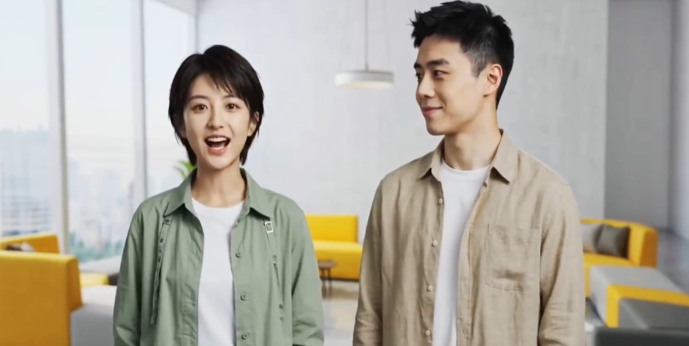
The debate over whether AI-generated dramas could replace traditional productions has intensified after Youhug Media unveiled two AI-generated performers, sparking concerns over portrait rights, industry ethics, and employment security.
The official Weibo account of Youhug Media published a post introducing two AI-generated performers, Qin Lingyue and Lin Xiyan, describing them as its first batch of signed AI digital stars. The two AI performers said in a video that they would appear in roles in the company's AIGC-produced drama series.
On March 14, the founder of iQIYI told media that a fully AI-generated commercial blockbuster could be produced as early as this summer or autumn, adding that this would be an industry-wide development. Also, Lu Beike, director of the historical drama Swords into Plowshares, gave an explanation of how AI technology is used. He said that it would take several weeks to complete a visual-effects scene with traditional computer graphics, whereas with an AI-based approach, one person could finish the same work within a week.
Although some of the advantages of using AI are being discussed, the move of introducing AI actors has sparked debate over portrait-right infringements and the survival of human actors. Under the introduction video, some netizens commented that the two AI performers bear a strong resemblance to several real actors. Whether generating characters or backgrounds, AI-based live-action dramas require "feeding" on real-world source material, making them prone to plagiarism controversies.
According to You Yunting, senior partner and intellectual property attorney, if the AI tool was trained without people's consent, the question arises as to whether this constitutes fair use. Legally, this is still debated. The second issue is if the AI user inputs a person's photo, resulting in the individual's likeness appearing in the short drama. In this case, the production team would be infringing on portrait rights.
According to a report by The Paper, the live-action short drama industry has suffered losses of over 90 percent, with AI-generated content replacing human-made works. A 2025 survey found that about 23 percent of short-video production teams are using AI-assisted filming, with small teams seeing a 15 percent layoff rate. Entry-level production roles such as lighting technicians are the hardest hit.
While some face job losses, others are seeing new opportunities. A media company recently took the lead in recruiting actors for AI-generated animated dramas, inviting actors to authorize their personal likenesses and voices so that AI can create digital versions. Actors receive an upfront fee and share in revenue once the series goes live. However, a lawyer from Beijing Yongqin law firm told The Beijing News that their use poses risks of infringing on personal rights, and current authorization systems remain unclear on scope, usage limits, and compensation standards.