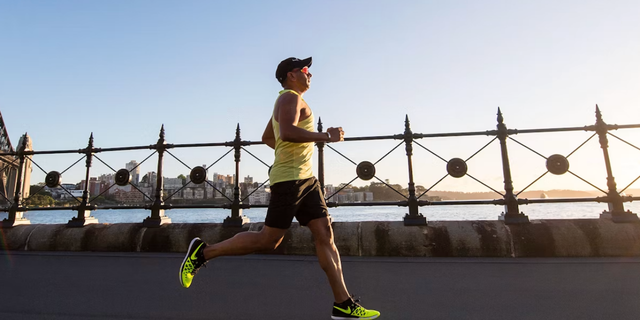
Yangshuo in southern China has long been a popular rock-climbing spot for Western tourists. Lately, though, a new group has arrived: office workers from China's big cities.
"I needed some exercise and outdoor activities to cope with the high-pressure work environment," said Chen Xue, a 28-year-old auditor from Chongqing, as she and other climbers looked out at Yangshuo's green mountains.
China's climbing boom is part of a wider fitness craze. Marathon runners have more than doubled since 2017 to over a million, and finishing times are getting faster, according to the Chinese Athletics Association.
Hyrox, a tough race that mixes 1-kilometer runs with strength tasks such as hauling weights, had 55,000 participants in China last year, up from 7,300 the year before. Newer racket sports are spreading too: the small city of Hebi now has about 1,600 pickleball courts and roughly 300,000 players, state television reports.
Hiking shoes, yoga pants and other athletic gear have also become stylish for China's middle class — even for people who rarely work out.
That has made fitness one of the brighter spots in China's consumer market. While many foreign brands face tough competition, athletic apparel is a rare field where companies such as Lululemon, Hoka and Adidas are still growing sales.
"Health is kind of the new wealth in China," said Rebecca Cai, Asia-Pacific general manager for Swiss running-shoe brand On. The brand said Greater China sales recently grew faster than the wider Asia-Pacific rate of 44%. It holds training meetups before marathon season, designs products for Asian body sizes, and sells sun-protective shirts and hats — a big concern for many runners in China. "The premium category is actually growing faster than the overall market," Cai said.
Kerry Pan, 34, works in luxury retail in Shanghai and usually watches her spending. For fitness, though, she is happy to pay more. She owns On and Brooks running shoes and spends up to about $300 a month at Temporary Humans, or TH, a Hyrox-linked gym she likes for its community and coaches. She has entered three Hyrox races in the past year, each costing more than $100.
TH classes often have wait lists, and its group chats are packed. After parents asked, the gym even added a class for 3- to 4-year-olds. Owner Han Lin is preparing a new Shanghai site nearly five times larger. "Wellness and fitness are taking over," he said.
Puma, Hyrox's clothing partner, reported a 9% rise in Greater China revenue in the first quarter. Amer Sports, parent of outdoor brands such as Salomon and Arc'teryx, saw sales there grow about 45% year-over-year.
Lululemon, which has struggled in the U.S., has found strong demand in China, where yoga and Pilates are popular among well-off city women. China accounts for more than half of its planned store openings this year outside North America, and the company expects double-digit growth to continue. It recently held Summer Sweat Games in Chinese cities, with kettlebell and pull-up contests in Shanghai.
But China's retail market is fiercely competitive, so success can fade fast. "Lulu was the only real premium brand in China for years and you're starting to see real competition," said Laurent Vasilescu, a retail analyst at BNP Paribas.
Los Angeles brand Alo has gained buzz online as travelers buy its clothes abroad to impress friends at home. "Young people might start with brands like Lululemon," said Lily Deng, a Shanghai content creator who stopped buying it because it felt too mainstream. "Then I started to learn about some more fashionable brands like Alo." Alo opened Chinese social-media accounts last month and is preparing to enter the country with a "Hello China" post on WeChat.
Chinese brands are rising too. Maia Active, owned by sports giant Anta, sells stylish sportswear for Asian body shapes at lower prices. Li-Ning is now one of the country's top sports-shoe brands among marathon runners. Xtep runs Saucony's China business and also sells its own shoes from about $30 up to high-end models.
Nike, a leading sports brand in China since the 1990s, has been losing ground to fresher local rivals. Vasilescu calls it the "microbrew effect": shoppers chase new flavors. Nike's Greater China revenue last fiscal year was down 29% from its peak five years ago. The company says it is fighting back with Chinese-designed products, a more premium look, and Hyrox training camps.
"We remain committed to serving the Chinese consumer and we're going to do it through sport," Nike chief executive Elliott Hill said on a recent earnings call.