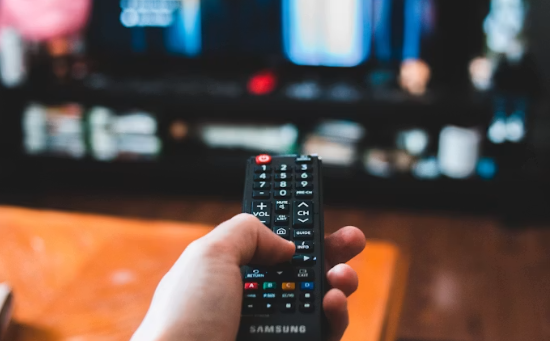
We're all watching a different show these days. Yet, whether it's scripted or not, when the opening credits begin, most of us click that little icon at the bottom right of the screen that says: Skip Intro. Maybe we're eager to get on with the story. Maybe it's boredom or too much anticipation that makes waiting feel unpleasant. Or maybe we're bingeing and can't be bothered to watch titles for a third time in one sitting. Either way, the phenomenon of bypassing the credits is a fairly recent one thanks to streaming platforms' growing role in entertainment. According to reporting on the topic, the trend started when a major streaming service noticed viewers were speeding through opening credits, so in the spirit of making customers happy, it added the skip feature. Now it's everywhere.
But it does come at a cost. The intro sets a mood and evokes the show's themes. It also creates a threshold between our busy lives and the ones washing over us from the screen. Clicking the button deprives us of this experience and an opportunity to slow life's pace. As a devoted fan of cinema and TV, I find the openers to be just that meaningful; however, as someone who has also binge-watched, I understand why we skip intro.
As a therapist, this phenomenon calls attention to other behaviors I observe in myself and others: the avoidance of an aversive experience, whether that's boredom, anticipation, or a distraction from other unpleasant emotions we're either unaware are happening or unwilling to engage with. This is experiential avoidance — the rigid act of stifling, ignoring, or withdrawing from events bubbling up inside of us or occurring outside of us.
Of course, skipping a two-minute introduction to a TV show is hardly the same as avoiding a social event out of fear of judgment, or binge-watching to ward off boredom or loneliness. Yet, by noticing the Skip Intro habit as a clue of experiential avoidance, we gain a subtle opportunity to practice mindfulness, which is simply awareness without judgment combined with an acceptance that what's happening is happening, without trying to push it away or alter it.
We all engage in experiential avoidance to some degree, because moving toward pleasure and away from discomfort is natural. However, just because it's inherent doesn't mean it helps us grow, and the brief intro could be a chance to get a little better at the skills of tolerance, mindfulness, and restraint. Everything in our world is in constant flux, whether that's our jobs, our age, or even our hourly mood and energy level. Our wellbeing is tied to our ability to be open, aware, and engaged with this reality. Our awareness of what's arising provides the window to be flexible, to adapt, and to ultimately grow.
Consider that for many of us, access to comfort and convenience has never been easier — a simple click results in speedy delivery of goods we probably don't need. Our diminutive role in producing life's necessities can remove our connection to meaning and purpose. In addition to setting a mood, the credits remind us that it takes a great number of people working together to create our shows — no small feat.
We are lucky to be so comfortable, but we have also set ourselves up to reward pushing unpleasant experiences away with a click. However, like trying to push a ball underwater in a pool, unpleasantness comes back up. These emotions might be useful — being open to engaging with them mindfully may release new insights and motivation. So, as we click away our unpleasant emotions and difficulties, we also click away opportunities for growth and meaning.
Hence, it's good to take a minute to practice slowing things down. Try it yourself. See what it's like to experience your life — whether that's driving to work in quiet, resisting the urge to check the phone, or, in the passive case of watching TV, sitting through the intro. How does it shift your perspective to notice aversion? What arises or dissipates as you observe without judgment? And how does your experience of the show change now that you're immersed in its world and your own?