There's pasta in the pantry and jarred sauce in the refrigerator. So what compels Kiely Reedy to keep having spaghetti with marinara delivered from the restaurant down the street, for several times the cost of cooking the dish herself?
It's not that the restaurant dish is particularly good, she said. "It's the instant gratification."
"I feel reliant upon it," she said, "but guilt for using it."
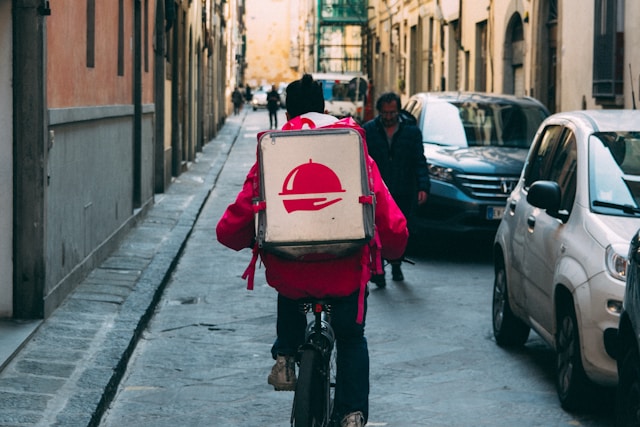
Food delivery has become even more entrenched in the years since as a convenience, an everyday alternative to cooking or eating out. DoorDash is now a verb. And the new delivery economy is transforming the way Americans live — reshaping budgets, mealtimes and social habits.
Many readers said they had impulsively ordered a single item for delivery: a coffee, a milkshake, a scoop of ice cream. Erin Molnar, a marketer in Ferndale, Mich., once paid about $15 for a tiny chocolate lava cake.
And for people who can't leave the home, food delivery is essential.
That message has a special resonance for the working parents we heard from. Between raising two young boys and putting in long hours at a marketing job in Atlanta, Kevin Caldwell can almost never find the time to make dinner. So he and his husband spend about $700 a week to order in.
'I Don't Go Out Anymore'
Missy Auge has most of her food delivered. She no longer feels the social pressure she once did to meet friends for dinner.
"I still have friends here, but I don't go out anymore," she said. "So I randomly see people, and they're like, 'I didn't know you were back!' "
Others said food delivery has actually made them more social.
Neha Kowal, an events director in Yardley, Pa., began ordering meals when her two adult children lived with her and her husband. But she has continued as an empty nester because it allows her to spend more time with friends.
"It has been a big forgiving act for myself," said Ms. Kowal, 54, who commutes an hour each way to New York City for work three days a week. "I would rather sit and catch up with a friend over a drink than worry about what we are going to have for dinner that night." She recently invited friends over, and "we DoorDashed dinner."
Many Generation Zers can barely recall a life without delivery, and their social lives now revolve around it.
Mercuri Lam, a Yale sophomore, said there's almost always a delivery driver outside her dorm, even though undergraduates living on campus are required to pay for a meal plan.
She and her friends spend many evenings ordering food to share, which she says costs less than going out and takes up less time.
While Ms. Lam, 19, has concerns about the pollution caused by the driving involved, she said delivery has expanded her palate. The first time she tasted Indian food was when a friend ordered it. And because delivery apps offer more photos and detailed descriptions than restaurant menus do, she is more likely to try something new.
The View From Outside
Still, such an on-demand lifestyle can keep consumers from developing critical skills like problem solving, planning ahead or making tough decisions, said Huy Do, a research and insights manager at the market research firm Datassential. That's why so many young people are "choosing to make financial and food-based decisions in the moment that feel good now," said Mr. Do, even though it can prevent them from making longer-term financial investments.
Ordering meals online also disconnects people from food and its preparation, said Yash Babar, a professor at the Wisconsin School of Business. Last year, he published a report showing that when food delivery platforms entered counties across the United States, residents spent an average of 9 percent less time cooking each day than they did before.
That disconnect extends to restaurants, many of which have accepted a trade-off: Delivery expanded their customer base, but they now have fewer in-house diners.
Will Parks, 36, decided to pare back after looking at his annual credit card report in 2024 and realizing that he had spent about a third of his money on ordering in.
"You feel kind of tricked," added Mr. Parks, who works in strategy for an entertainment company in Los Angeles. "You have reshaped your life based on their business model."
In weaning himself from delivery, he has discovered a new passion — something that allows him to step away from his phone, focus on a task and feel a sense of accomplishment: cooking.
Preparing a meal takes far more time than ordering dinner with the press of a button. But "it feels good," he said. "It feels more adult, frankly."