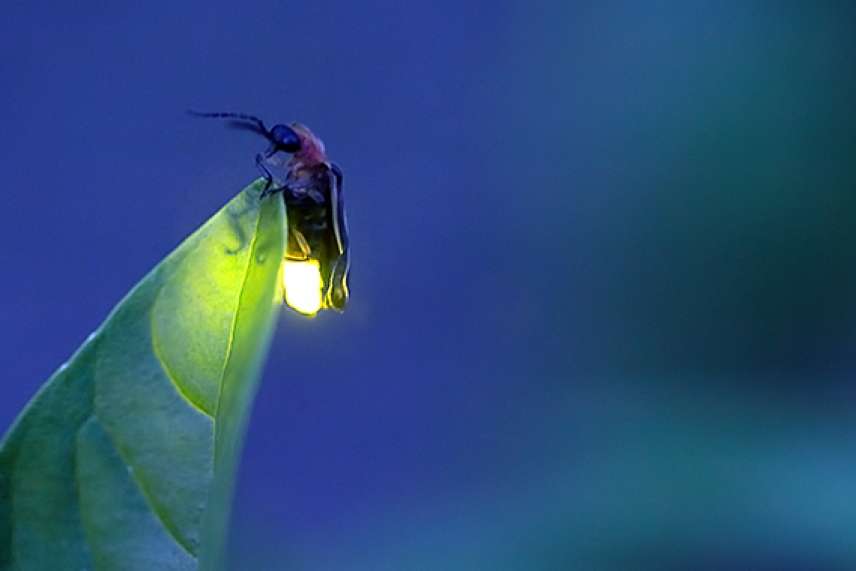
If you visit the Allegheny National Forest in Pennsylvania in early July, get ready for a spectacular sight that happens in only a handful of places worldwide. As the sun sets over the mountains, the darkening hemlock and beech forest lights up with flickering fireflies. While most fireflies (or "lightning bugs") emit light individually as a form of male signaling, the Alleghenies are among the few places where fireflies flash in synchrony. Every summer, members of the species Photinus carolinus — also found in the southeastern U.S. — gather to put on this light show.
The biological reason for firefly synchrony remains elusive, but researchers have made progress in uncovering the mathematical mechanism behind the synchronous rhythms. In a recent study, computer scientists at the University of Colorado Boulder captured male P. frontalis (another synchronous species from the Southeast U.S.), isolated them in a dark tent, and experimented with flashing LED lights. The males synchronized their flashes with the LEDs, provided the LED flashes occurred shortly after the male's own burst of light — a pattern that fits a mathematical "phase-response curve."
The effect is mesmerizing. In an interview, math graduate student Owen Cardwell, who witnessed a P. frontalis light show, recalls, "It was cool, like you just sit in there and the fireflies are blinking around you in sync. It's not like anything else. Normally with fireflies, there's a blink here, a blink there, but this was all at the same time."
Five species of firefly are known to synchronize their flashes, three in North America and two in Asia. Until 2012, Photinus carolinus was known only from the southeastern states, with light shows reported in Tennessee's Great Smoky Mountains. A 2012 survey of fireflies in Pennsylvania confirmed reports of P. carolinus in the Allegheny National Forest.
Males of the 15 other firefly species recorded in Pennsylvania flash individually, creating seemingly independent displays. In contrast, P. carolinus males streak through the forest simultaneously, leaving trains of flashes that resemble holiday lights suspended for a split second. After 6 to 15 seconds of darkness, they repeat the performance, continuing this cycle for up to two hours on a peak night.
In the southeastern P. carolinus populations, the display peaks from late May into early June, while in the Allegheny population it occurs from late June into early July. An annual Pennsylvania Firefly Festival celebrates the uniqueness of the behavior.
Fireflies are beetles that, in most species, emit light from bioluminescent organs ("lanterns") on their abdomens to attract mates. Males have two lanterns, while females have one. In P. carolinus, male fireflies flash 5 to 8 times, then pause, and any females observing the display flash back twice. Flashing patterns are species-specific, so a female will respond only to a male of her own species.
A female P. carolinus can mate several times during her short lifespan, so males benefit from continuing to flash their courtship signals while females are present. Males emerge first from their burrows each night and wait; once females emerge, the courtship signals intensify, with more flashes per flash train.
Watching synchronous fireflies is straightforward. "I would do it again," adds Cardwell. "It's not that hard to see them."
Timing, however, is everything. Flashing activity, according to a NatureServe page, "typically begins 37-43 minutes after sunset." One visitor to the Allegheny National Forest reported that the activity was concentrated between 10:30 and 11:15 PM. Seeing the fireflies during peak activity has become so popular that tickets are required — and hard to come by.
During the original annual Pennsylvania Firefly Festival, 150 lucky people won tickets by lottery to see the fireflies from the property of a couple, the Butlers, whose bed and breakfast became a viewing hub once the population was discovered. Visitor numbers quickly skyrocketed to unsustainable levels — since females emerge from their burrows onto the ground, they risk being trampled. Now, the Butlers limit both the number of visitors and the duration of visits.
"People have to be careful not to love something so much that they destroy the habitats and the insects themselves with human impact and activity," explained Peggy Butler. "Tourists need to educate themselves about the fireflies and the places that they are going to go in order to see them."
As of 2026, the Pennsylvania Firefly Festival is held at the Market Village in downtown Tionesta, with guided tours at the Tionesta Lake Visitor Center. Tickets are distributed by lottery and sell out quickly. Alternatively, chatting with the park rangers can turn up insider tips about where and when to see the dazzling display.
While it's reportedly quite difficult to capture photos or video of the synchronous displays, examples can be found online. Enjoy the sparkle!