
"Nothing is so great an example of bad manners as flattery. If you flatter all the company, you please no one; if you flatter only one or two, you offend the rest." ― Jonathan Swift, refusing to flatter his readers.
When you teach a course in which the topic of flattery comes up, it is hard not to get self-conscious. Thoughts of whether you are flattering the students or whether they are flattering you, and whether there is too much or too little of it, can be quite distracting. Over the centuries, the moralists have been clear and adamant in their condemnation of flattery. This was easy work because they had already defined flattery as insincere and self-serving speech.
We should not conclude from this that it is wrong to ever say anything nice or laudatory to another person. There must be a place for compliments, for praise, for constructive encouragement, for benign boosts of confidence. What we need is a criterion of demarcation that tells us where positive and morally valid speech ends and flattery begins. In an earlier essay (Krueger, 2020), I explored the distinction between genuine appreciation and insincere flattery. To that I now add the notions of frequency and timing. Appreciation depreciates faster with repetition than flattery does. I have no empirical data to support this claim, but a strong intuition. Flattery caters to an unquenchable thirst, whereas the power of appreciation is greatest if it is delivered rarely and just at the right time. A sensitivity to timing reveals the agent's (speaker's) intentionality and the absence of ulterior and self-serving motives.
It is commonplace to fault flatterers for their flattery — unless you are the flattered. The Book of Proverbs condemns the evil tongue, not the evil ear. Yet, the targets of flattery often play a colluding role, enabling and sustaining flattery, perhaps with favors, leniency, or undeserved forgiveness. A collusion between the flatterer and the flattered, at the expense of third parties who are excluded from the exchange of favors, is possible (Rogers et al., 2023), but their exchange relationship is an unstable one. To see how this is so, consider their interdependence as an instance of the prisoner's dilemma.
In the figure below, we find the flatterer (the agent) as the row player and the flattered (the target) as the column player. The 2 x 2 preference matrix results from each player having a choice between two strategies, one designed to please the other player (flatter & reward) and another designed to stay neutral (rest), that is, to not engage. The numbers indicate the preference ranks from 4 (best) down to 1 (worst), with the numbers to the west (east) of the comma pertaining to the agent (target).
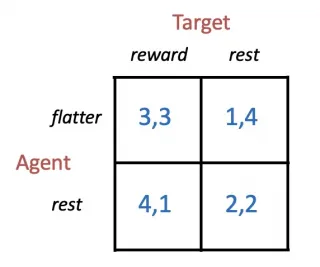
The two players' preferences are not well aligned with each other. The agent would like to be rewarded while resting; the target would like to be flattered while resting. If both players honor traditional game-theoretical rationality, they will realize that whatever the other player does, they themselves are better off resting. Rest-rest is a Nash equilibrium. Neither player has an incentive to unilaterally switch strategy, while both know that if they were to jointly switch strategy, they would be better off, individually and collectively. Notably, any third party of observers might be damaged by a flatter-reward collusion. Their complaints would be legitimate; alas, they are often reduced to writing tracts on morality.
Although the game-theoretic perspective does not predict which agent-target pairs will stay at equilibrium and which will successfully collude to mutual benefit but at a cost to third parties, this perspective captures the fragility of flattery vs no-flattery dynamics. This fragility is greatest in brief or one-time encounters. When repeated play is allowed, with continual exchanges of flattery and reward, a stable mutual-admiration society can emerge and sustain itself (Rossetti & Hilbe, 2024).
Technically, then, a flattering agent defects from all other interested parties when cooperating with a flattered target. To visualize this, we would need to turn the preference matrix into a preference cube. Against this slightly dispiriting background, the value of genuine appreciation should come again into focus. Sincere appreciation creates a "win – win – no-lose scenario". The target feels respected and understood, the agent can pocket the warm glow that comes from having done the right thing, and the third parties have at least been treated to a lesson in how human relations can be improved with no cost to anyone.
The brilliant mind of Jonathan Swift (see epigraph) saw beyond the moralistic frame. Swift considered flattery stupid rather than evil, not in the least because unskilled flatterers overlook the impression they make on third parties.
In the beginning
The original title of this post was The Dance of Flattery. The title that you see was chosen by the editors of PT. If you think that this title does not represent the essay's contents well, you are not alone. The essay was not written to answer the question of whether flattery is wrong. When I shared this bit of background with a friend, she said the original title was much better, and that she was not just saying that to flatter me. Thank you, my friend, I take this as an expression of appreciation!