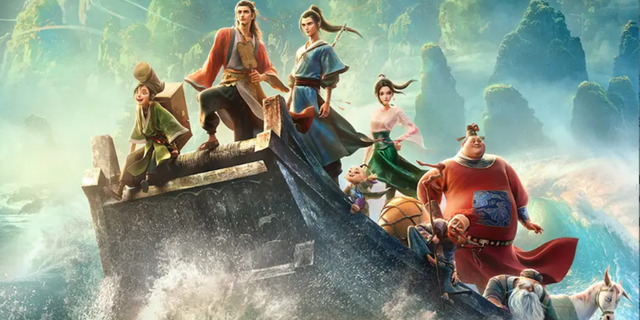
Chinese animated feature All Wishes Come True! stormed into cinemas on Saturday, quickly crossing the 200 million yuan ($29.5 million) box-office threshold in its opening weekend. The film opened with a high 8.3 out of 10 score on Chinese review website Douban, temporarily ranking first in reviews among all new releases in the 2026 summer season.
Departing from conventional Chinese mythic storytelling that centers on divine ascension, the film zeroes in on the mortal, grassroots lives of the Eight Immortals before they achieved godhood, breathing new life into a beloved Chinese legend with relatable characters.
On Chinese social media, many viewers commented that they were amazed by the film's exquisite Chinese-style aesthetics and hard-hitting traditional martial arts sequences, saying it is sure to be a "dark horse" during the summer film season.
The film is rooted in one of China's most iconic folk tales, "The Eight Immortals Crossing the Sea," a myth that follows the eight Taoist immortals — each with distinct personalities and magical powers — as they traverse the Eastern Sea using their unique treasures rather than a boat, giving rise to a proverb celebrating individual talent within collective effort.
Despite its cultural ubiquity, the tale has seen few successful screen adaptations, a gap director and screenwriter Mu Zhengyang sought to fill. "I grew up on Chinese classics like Journey to the West and Romance of the Three Kingdoms, and I always wondered why no one had tackled the Eight Immortals," he said.
The myth's fragmented, folk-derived narrative posed challenges, but its core appeal lay in the eight immortals' rare status as a group of mortals-turned-deities, evolving over centuries to embody ordinary people's hopes and values.
Rather than depict the immortals as aloof, perfect beings, Mu reimagined them as flawed, relatable mortals with personal desires and conflicts. Drawing from the Ming Dynasty (1368 – 1644) novel Journey to the West and folk tales, the team crafted distinct personalities for each character, emphasizing their youthfulness and human flaws to generate both drama and comedy.
Mu revealed that the film's visual style is rooted in traditional Chinese culture. The design team drew inspiration from ancient paintings and New Year prints featuring the Eight Immortals and adopted the traditional Chinese five-color system to give each figure a distinctive look.
Hidden patterns on the characters' clothing echo each character's background: Zhongli Quan is marked with tiger patterns to reflect his complex personality; He Xiangu is decorated with lotus embroidery; and Tieguai Li, the herbalist immortal, wears robes patterned with medicinal plants.
Action sequences, a highlight of the film, were choreographed by veteran martial arts directors, blending authentic kung fu styles with character-driven combat.
"Each character's fighting style is tailored to their personality: Lü Dongbin uses disciplined orthodox kung fu, He Xiangu delivers powerful and domineering blows, while Tieguai Li adopts unrestrained, street-style fighting reminiscent of the beggar's sect martial arts," Mu said.
At its core, All Wishes Come True! asks what it really means to become an immortal.
"In our story, eternal life and flying on clouds don't make you a god," Mu said. "In the end, only these eight step forward to protect the people. True divinity isn't about power — it's about having the courage to stand up for others."
The film's English title underscores its core theme of "granting every wish" — a narrative throughline that drives the immortals' journey from self-interest to selfless heroism.
"I want audiences to know that doing the right thing will always matter, even if the result isn't immediate. Someone told me they decided to become a kinder person after watching. That's exactly it," Mu noted.
Reflecting on Chinese animation's global standing, Mu argued that technical prowess is no longer the differentiator. "What's irreplaceable is the Chinese stories that carry unique Eastern values and philosophy," he said.