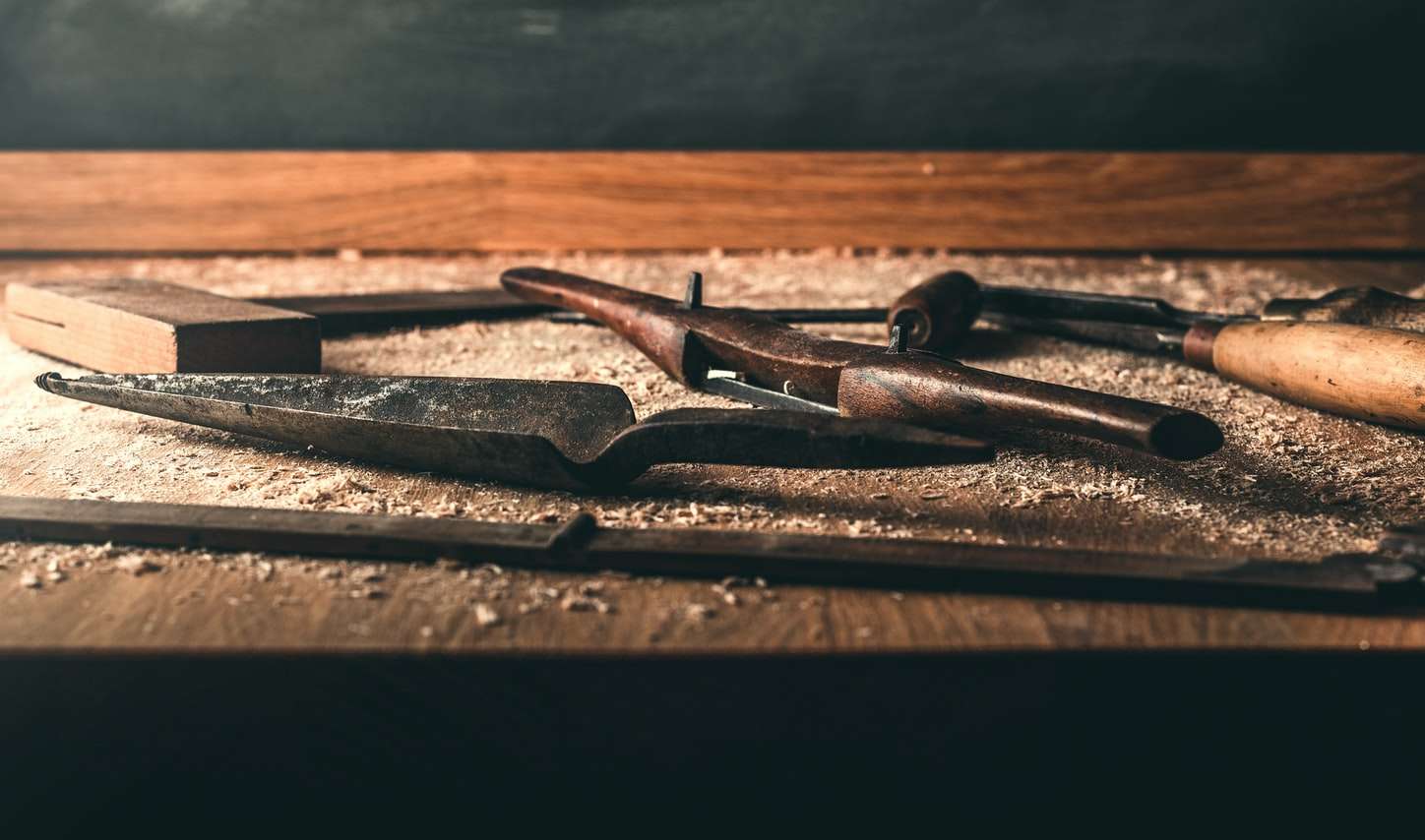
College sophomore Ian Vanveen, 20, got into woodworking as a way of managing a budget. "I didn't have a whole lot of money," he says, "so I decided to build what I wanted myself." The mostly self-taught craftsman started off making furniture, but was eventually itching to do more.
So Vanveen took a carpentry class to learn about different woods and their properties. There, he discovered things like how different kinds of wood can vary in density, and how wood's fibers can expand or shrink depending on humidity. He then decided to combine his newfound knowledge with his building skills and start making electric guitars.
"That's when things got interesting," he says.
A first attempt, sort of
The first electric guitar that Vanveen handled was his dad's old band guitar. A high schooler at the time, Vanveen immediately felt a connection with the instrument, and got it into his head to make his own custom six-string.
So he set up shop in his family's garage and got to work. He took a bunch of pine boards left over from a home deck project, "and just cut it up and glued all the pieces together," he says. "It turned out really bad."
The second one, with a plan
Vanveen took a couple of years off before he started crafting a second guitar, though this time he went in with more planning and forethought. While a fan of one classic body shape, slightly asymmetrical with a rounded top and a larger rounded bottom, the student found it "notoriously thick, and really uncomfortable."
He decided instead to create the thinnest guitar possible without having it warp over time. Slimmer guitars are more susceptible to changes in humidity, temperature and high string tension. Another non-negotiable: Vanveen wanted the instrument to sound loud when he played it even when it wasn't plugged into an amp. "I was really adamant about this."
His first step was sketching a model of the instrument on a computer. "I didn't have any of the dimensions, really," says Vanveen. "I just figured that out as I went."
For this project he used maple, a stiff and dense wood known for its stability. He then took a couple of weeks to test its strength and see how thin he could get it while still withstanding maximum string tension. "I got it down to an inch and an eighth," he says. "If I went any lower than that, the whole body would bend over time."
Cutting, hollowing, wiring
Vanveen used a miter saw, good for making quick angled crosscuts, to cut individual wood boards, creating what would become the guitar's rough shape. He then used a jigsaw for hollowing out the piece and contouring, and a drill to make holes for the electronics.
These include adjustable potentiometers, electrical components that allow a musician to control the instrument's volume and tone, and a capacitor to filter its frequency, the speed at which its strings vibrate, and shape its tone.
Since Vanveen wanted his guitar to sound loud even without plugging it in, he hollowed out the entire instrument, other than its center, where the wiring is now located, using a handheld router.