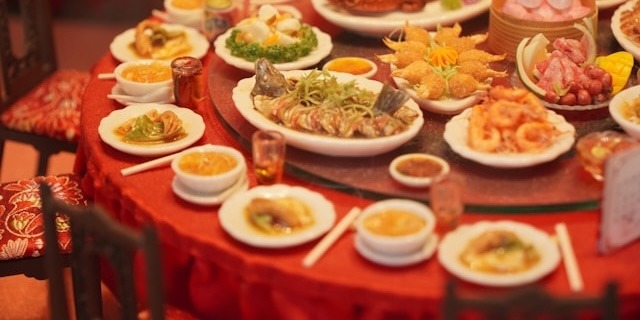
Sumptuous and culturally significant, the family reunion dinner, served on Spring Festival eve, is a 4000-year-old tradition passed down through generations in China. A hearty feast, the dinner is also a historical record of Chinese traditions and culture, with every dish containing its own auspicious symbolism.
Dumplings
With a history of more than 1,800 years, dumplings, also known as jiaozi (饺子) in Chinese, are a traditional dish eaten on Spring Festival eve, especially in northern China.
In Chinese, the pronunciation of dumplings sounds the same as 交子 (jiaozi). 交 means “exchange,” while 子 means the midnight hours. Combined, jiaozi means the exchange between the old and new year, while people who eat dumplings are said to leave the past behind, and embrace a new year.
Glutinous rice balls
Glutinous rice balls, or Tangyuan (汤圆), is a sweet dish served during the Spring Festival in southern China. Unlike dumplings, the dough of Tangyuan is made using glutinous rice powder and has a sweet filling made of ingredients such as red bean paste, fruit and brown sugar.
The rice balls are usually cooked and served in boiling water with fermented glutinous rice and sweet ginger syrup, though in some regions, they can also be deep-fried to add a stronger flavor. Glutinous rice balls are usually shared among all family members. Their round shape signifies family togetherness, while tangyuan is a homophone for union (团圆-tuanyuan).
Vegetable stew
Though the choice of vegetables may differ in different regions, several familiar vegetable dishes are eaten across China during the new year. For instance, one recipe including Chinese cabbage and lotus seeds is popular during the Spring Festival, as in Chinese, cabbage is a homophone of "unlimited wealth," while lotus seeds represent a blessing for many children and a healthy family.
In south China, bamboo shoots are considered a lucky vegetable dish for the reunion dinner, as they represent longevity as well as good fortune. In north China, the leek is typically made into a salad or a filling for dumplings, because it sounds similar to 久, meaning everlasting fortune.
New year fish
For every Chinese family, fish is an indispensable part of the reunion dinner. In Chinese, fish has the same pronunciation as 余 (yu), which means surplus. For Chinese people, it is always good to have saved something by the end of the year, so that more good fortune will follow.
Red braised pork belly
Red braised pork belly is a traditional Chinese dish with a history of over 1,500 years. In his famous book, Qi Min Yao Shu, agronomist Jia Sixie explained the dish's cooking process, noting that this dish was a firm favorite during the 5th century.
This dish is a reminder of Chinese idiom 红红火火 (red and fire), which means to prosper as much as red fire.