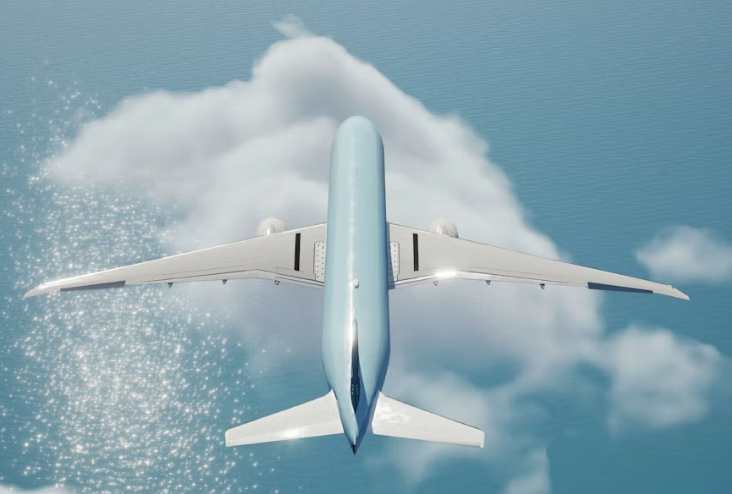
Ever wonder how you're able to use the internet 36,000 feet above the ground? Here's how in-flight Wi-Fi keeps you connected.
Having to put your devices on Airplane Mode while flying is frustrating — doubly so when you're on a business trip and need to stay in touch with the office, or flying with kids who could really use a distraction. Luckily, in-flight Wi-Fi keeps you connected. But how does airplane Wi-Fi actually work at 36,000 feet above the Earth?
How does airplane Wi-Fi work?
Internet systems on airplanes are based on two kinds of technology: ground-based and satellite.
Air-to-ground (ATG) Wi-Fi works similarly to Wi-Fi on your cellphone. An antenna located underneath the aircraft links up with ground-based cell towers. As the plane travels, it connects to the nearest transmitter on a rolling basis, ensuring continuous internet access. The airplane essentially becomes a hot spot, so passengers can do everything they'd normally do online — send emails, make calls, and stream music and movies.
But this system breaks down when the plane flies across remote areas or over large expanses of water, like trans-Atlantic routes. That's where satellite Wi-Fi comes in.
Satellite Wi-Fi uses a network of orbiting satellites to connect to the internet. The satellites are linked to ground stations, and the airplane connects via an antenna on the top of the aircraft. There are two main types of satellites in use. Geostationary Orbit (GEO) satellites sit approximately 35,786 kilometers above the equator and provide broad coverage, though they can experience longer delays in data transmission. Low Earth Orbit (LEO) satellites, by contrast, orbit at altitudes between 500 to 2,000 kilometers and offer faster speeds — companies such as SpaceX's Starlink are leading the development of LEO networks for aviation.
Satellite Wi-Fi also operates on two bandwidths: narrowband and broadband. Both allow in-flight internet access, though narrowband is less suited for streaming video.
How fast is in-flight Wi-Fi?
Speeds typically range from 32 to 195 Mbps per aircraft, depending on the system and provider. For context, 100 Mbps is considered "fast" on the ground — though your home internet may well exceed that.
Since all passengers on an aircraft share the same bandwidth, speeds can slow during peak usage. High flight speeds and altitudes affect signal strength, remote routes mean sparser coverage, and severe weather can interfere with satellite-based systems. To counter this, many airlines use a combination of Wi-Fi providers and technologies.
Tips for getting online midflight
Connecting to the airplane's Wi-Fi is the only feasible option once you're airborne — the speed and altitude of the aircraft make it impossible for phones to establish stable connections with cell towers on their own. To make the most of in-flight connectivity, it helps to check your airline's Wi-Fi offerings and route coverage before flying, avoid streaming high-definition video or downloading large files, and download necessary content beforehand so you're not entirely dependent on in-flight speeds. Connecting midflight, when fewer passengers are online, can also mean better speeds.
Do all airlines provide Wi-Fi, and is it free?
Most airlines inform travelers about in-flight Wi-Fi at the point of ticket purchase and again when boarding. It typically involves turning on Airplane Mode, then finding the in-flight network in your Wi-Fi settings or a browser.
Whether Wi-Fi is free depends on the airline. Some offer complimentary access; others charge based on time connected or bandwidth used. The landscape is shifting quickly, with more airlines moving toward free or subsidized Wi-Fi as the technology becomes more reliable and cost-effective.
While some airlines market their Wi-Fi under their own brand, the network itself isn't proprietary — the plane simply acts as a hot spot, connecting to whichever cell tower or satellite is nearest.
As in-flight Wi-Fi becomes as standard as beverage service, the rules, speeds, and prices will keep evolving. But once you understand how it works, you might find it worth the occasional investment when work can't wait until landing — otherwise, there's always the window seat and a good book.