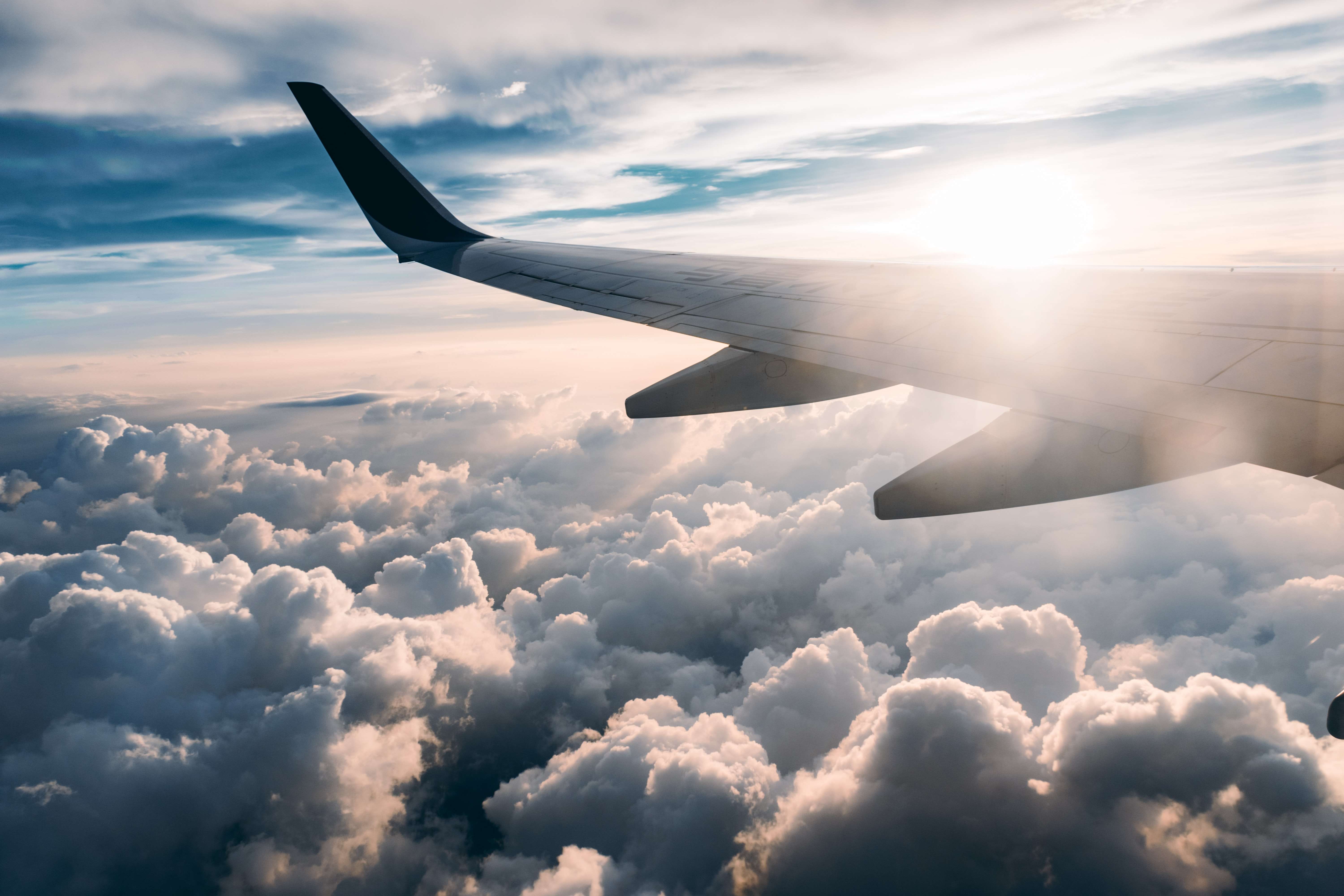
The Earth is spinning under us all the time. So why can't a plane simply take off, hang in the air, and wait for its destination to come around? It is a reasonable question, and the answer has nothing to do with planes being special.
For a start, imagine you could take a really big jump up into the air (on a non-windy day, for simplicity) at the equator, where the surface is carried around fastest by the Earth's spin. Let's put you on a trampoline, and assume you can hang in the air for a moment at the top of the bounce. Where would you expect to land? If the ground really did slide out from under everything that left it, your answer should be a long way to the west of your trampoline.
Now you'll notice that the world isn't filled with people flying off their trampolines and hurtling through the air at speeds faster than commercial airliners. This doesn't happen. But not because the Earth isn't spinning.
You move with the Earth because of your inertia, or the tendency for objects in motion to remain in motion in a straight line at the same velocity unless another force acts upon them. This is why when you leap directly into the air, be it directly from the ground or inside a windowless truck, you land where you began. Moving in another direction requires a force in that direction, such as jumping forwards, or an airplane expelling mass. Planes do not have magical properties that excuse them from inertia, and so when they take off from the spinning Earth they must expend energy to carry you somewhere like Hawai'i.
It is also tempting to assume that our atmosphere is somehow static while the Earth spins beneath it. This is simply not the case. The air is not shoved along by friction: it carries its own angular momentum, and turns with the planet for the same reason you do when you jump. Friction with the surface only keeps the two in step. If the atmosphere were not turning with our planet, you could utilize the insane relative wind speeds to decrease flight time, but you'd probably not be concerned with such problems as "long flights" when you are being battered constantly by incredibly high winds every moment of your waking life.
In fact, flying west (against the rotation of the Earth) takes a little longer than flying east. "The reason for quicker flights while flying eastwards is jet streams," Simple Flying explains. "Put simply, these are fast-flowing, narrow air currents in the atmosphere found at high altitudes."
This does have a little to do with the Earth's rotation, as well as the atmosphere being heated by the Sun. Those streams are westerlies: at the mid-latitudes and cruising altitudes of a long-haul flight, they blow from west to east, which is why an eastbound plane gets a shove and a westbound one has to push through a headwind.
Why they exist at all is a matter of heat. The Sun warms the tropics far more than it warms the poles, and that imbalance is what sets the whole atmosphere circulating, carrying great masses of air between the equator and the higher latitudes.
Air on a journey that long does not track straight over the ground beneath it. The closer you are to the equator, the greater the linear speed at which the surface is carried by the spin, so a large flow drifting away from the equator ends up over ground that is being carried more slowly than the ground it set out from, and it runs ahead of that ground. In the northern hemisphere, air moving on this scale is deflected to the right of its path, and in the southern hemisphere to the left. Air heading away from the equator and towards the poles is therefore swung eastwards, and it is that steady eastward push, at the altitudes where long-haul planes cruise, that keeps the jet streams running from west to east. It is a bias that shows up only across vast distances and long stretches of time, which is why a single plane — or a single jump on a trampoline — is not visibly shoved sideways by it.
So the rotation of the Earth does (indirectly) affect flight times through its effect on wind speed and direction. But you cannot simply take the plane into the air and wait for the Earth to pass beneath you.