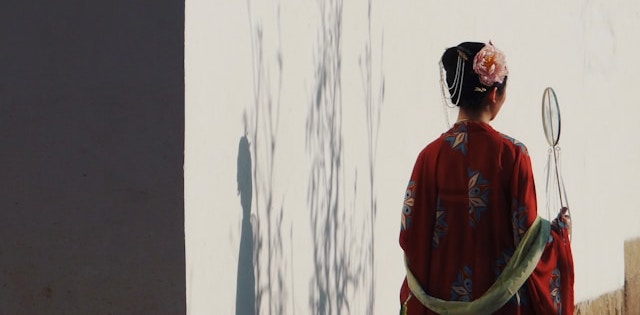
With the Spring Festival approaching, discussions about what to wear have once again come to the fore. Recently, hashtags such as "light Chinese-style outfits go viral" and "Guangdong markets predict this year's spring-summer fashion trends" have trended on China's social media platform Weibo, attracting tens of millions of views.
This seasonal dilemma is quietly reshaping market preferences. In the year of 2026, the term "light Chinese style" is already popular. Unlike the earlier wave of new Chinese style fashion, which was instantly recognizable through strong visual symbols, light Chinese style takes a more understating approach. It is gradually evolving from a set of overt cultural markers into something that is more everyday and practical.
In markets like Shenzhen, heavy festive wear is being replaced by subtle pieces like stand-collar shirts with a single frog button.
The emergence of light Chinese style may reflect a new phase in Chinese aesthetics rather than a fleeting fashion trend.
"In recent years, new Chinese style addressed the question of being seen," Wang Deyan, a scholar of aesthetic and cultural studies, told the Global Times. "Through highly recognizable symbols, it brought Chinese aesthetics back into the mainstream. What needs to be addressed next is whether it can be worn over the long term."
According to Wang Deyan, both the market and consumers are now consciously dialing down the "intensity" of Chinese elements. "If a piece of clothing can only be worn during the Spring Festival, its life cycle is effectively locked to the holiday."
Rather than clear festive references, consumers today care more about whether a garment works across multiple everyday scenarios - family visits, commuting, and daily outings, Wang Deyan noted.
"When Chinese aesthetics shift from overt symbols to expressions of structure, proportion and overall temperament, they truly enter everyday life," he said. "Light Chinese style is accepted precisely because it no longer emphasizes being recognized, but being usable."
"What people want is a Chinese sensibility, without being confined to a festive context," Wang said. This shift is evident among consumers.
Wang Mengqi, a Beijing-based office worker, told the Global Times that the clothes she bought for this year's Spring Festival deliberately avoided obvious holiday elements. Instead, she chose a light-colored stand-collar shirt and a structured outer layer. "My family can tell there's a Chinese feel to it," she said, "but it doesn't feel out of place when I go back to work after the holiday."
In her view, light Chinese style is not designed to please any specific occasion, but to align more closely with contemporary lifestyles.
From market forecasts and design choices to consumer behavior, the rise of light Chinese style is no coincidence. The Spring Festival, as a special holiday, amplifies people's demand for clothing that is both versatile and long-lasting - allowing a form of Chinese aesthetics that does not rely on labels to move more quickly into the spotlight.
When Chinese style no longer needs to be repeatedly emphasized, it becomes easier to endure. Light Chinese style is finding its way into wardrobes in a more everyday and lasting form.