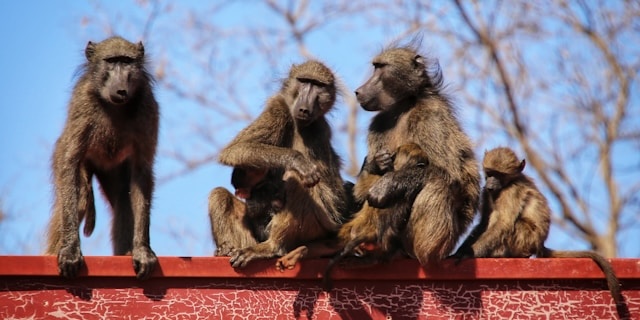
If you have siblings, you may remember fighting for your parents' attention when you were younger. It turns out sibling rivalry isn't just something that affects humans. A new study has found that young baboons try to steal their mothers away from their brothers or sisters.
Scientists observed baboon families in Namibia between August and December 2021, and noticed that when a mother was grooming a child, a sibling — often an older one — would try to interrupt them. The baboon vying for parental attention would bite, slap, cry and sometimes even lure their sibling away in order to supplant their place in their mother's arms.
Because baboons usually have one baby every 18 to 24 months, "it was generally thought there was no real competition between siblings, because brothers and sisters are different ages and do not necessarily need their mother and her resources at the same time," explains Axelle Delaunay, a behavioral ecologist at the University of Turku in Finland and the study's first author, to Agence France-Presse.
However, sibling interference in baboons "strikingly mirrors patterns of sibling jealousy reported in humans," Delaunay and her colleagues write in their study, published in the journal Proceedings of the Royal Society B on February 11.
"It's totally relatable," says Joan Silk, a primatologist at Arizona State University who was not involved in the work, to Annie Roth at the New York Times. "I have two sisters and two children, so I can relate, but the fact that it's relatable doesn't always mean it's true."
In this case, it likely is. "This group of researchers has really pushed the envelope about what we know about relationships between individuals," Silk tells the Times.
Overall, Delaunay and her team found that baboons are more likely to interfere when their mother is grooming a sibling than when she is resting and already free. Offspring were also twice as likely to interfere against their younger siblings, and targeted siblings of the same sex more often. Interference was most common between brothers, they found.
Female baboons also have "favorite" children that they groom disproportionately more than others. The researchers found that the baboons target that favorite child, lending more evidence towards the idea that the interrupting behavior is motivated by jealousy. "Our findings further indicate that baboons are aware of their own maternal bond relative to those of their siblings," the authors write in the study, though further studies are needed to determine the cognitive complexity of these skills.
And good news for the mothers: the jealous behavior faded away as the baboon got older.
Delaunay and her team aren't sure what benefits these displays of sibling rivalry have for the jealous offspring. While sibling interference interrupted bouts of grooming in 19 percent of instances, it was only successful in getting the interrupter access to grooming by their mother in 9 percent of cases. "Most of the time, interference doesn't really work," Delaunay tells the Times. "So what are the benefits?"
She hopes that future research will answer that question, and that more scientists will study primate emotions. "While we can't ask them how they feel, we know that emotions provoke physiological changes, behavioral changes, some cognitive changes — and this you can measure," she adds.