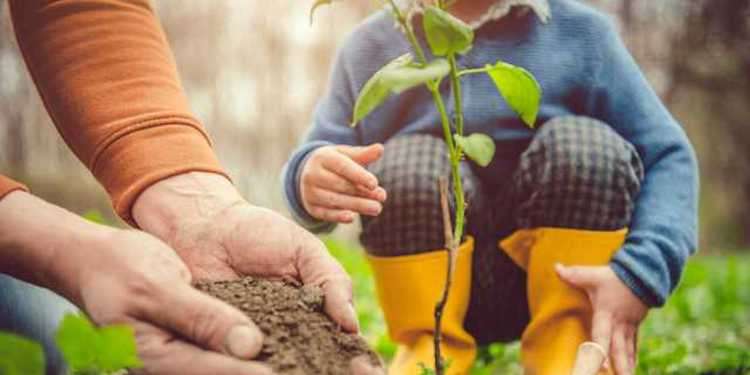
It's hard to make people more eco-friendly. New research finds a potential solution: children. In studying the spillover effects of environmental education within families, researchers found that children had more of an impact on changing their parents' behaviors and mindset.
Getting people to change their behavior is a challenging task. Those hurdles are especially pronounced when it comes to climate change, where overcoming the intention-action gap is a major challenge.
So what might actually help change people's behavior? Researchers at Northeastern University found that children may hold the key to changing their parents' behaviors around climate change.
The convention might be to think parents are better teachers, but, "It does show us that probably kids are better teachers than parents are," said Nirajana Mishra, an assistant professor of marketing at Northeastern.
With support from the World Bank, Mishra and an interdisciplinary team conducted a field study enrolling more than 1,500 families with children in grades 6 to 8 in an environmental education program in Patna, India. Patna faces severe environmental issues like air pollution, flooding and rising temperatures.
Beyond the environmental context, Mishra and co-author Nishith Prakash were interested in seeing the effect of family dynamics. Within Indian households, there is still more of a hierarchy. "The context in a place like Patna is, there, parents still wield some authority over kids," Mishra said.
The team was curious to see if children could bring back to their homes what they learned.
Over a week, trained educators visited each family's home for four 30-minute lessons. To test the spillover effect, researchers randomly assigned families to one of three groups: one where only children took part, one where only parents took part, and another where both received education. There was also a control group.
The curriculum aimed to raise awareness about environmental issues, the impact of behaviors, and what advocates are doing to combat climate change.
Importantly, the lessons were designed to be interactive, making space for conversations between parents and children to create a potential "spillover effect." "If you just do a plain session, nothing is going to work, so you have to make it more fun, more engaging," Prakash said.
To figure out whether these lessons had any effect, researchers gave out completion certificates at the end. Families could choose to either immediately get a certificate printed on standard paper or wait a week to receive a recycled paper version.
Parents who took part in the program were more likely to choose a recycled certificate, but their children were not equally as likely. But parents whose children did participate, either by themselves or with their parents, were 26% more likely to opt for a green certificate.
Interestingly, children also had more of an effect on their parents' perception of the risks posed by climate change and the sense that their actions could make a difference. Parents had little to no effect on their children's perceptions.
Of the six environmental behaviors the researchers focused on, children had a spillover effect in four. Parents only had one: the completion certificates.
"It's hopeful in itself that kids can make these changes, but it is more so to me that it is happening in a context where I would not have predicted this to happen," Mishra said. "Even when parents hold more decision-making power, for a topic such as the environment, kids are better messengers."
For Megan Willig of the National Environmental Education Foundation, it's surprising but not hard to see why. "Kids are really curious, they ask a lot of questions, they then pose the questions to everyone else in their life," Willig said. "Their learning doesn't just stop after the school day. They take it home."
Mishra and Prakash are interested in the fact that their discovery could point to a potential new strategy for environmental advocates and educators with smaller budgets. "If I'm resource-constrained and if I have to choose who to target in a household, perhaps kids are better targets in terms of changing attitudes," Mishra said.