Ten years ago, China's commercial space industry was still a small and uncertain experiment.
Private rocket companies had limited funding, little flight experience and plenty of doubters. Some experienced engineers believed that launching rockets was simply too difficult — and too important — to be entrusted to young businesses.
Then, on the morning of August 19, 2026, a rocket landed upright in the desert.
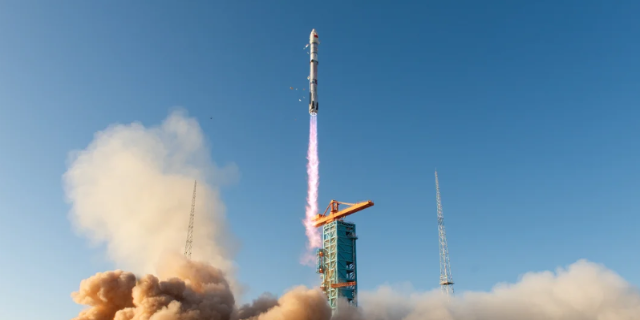
The Zhuque-3 Y2 lifted off at 7:35 A.M. from northwestern China. About 137 seconds later, its two stages separated. The upper stage continued into space and placed the Honghu-03 satellite into its planned orbit.
The first stage began its journey back to Earth.
At around 7:41 A.M., the booster descended toward a landing site in Minqin, Gansu Province. It restarted its engines, opened its landing legs and settled vertically onto the ground. When the dust cleared, the more-than-40-meter-tall booster was still standing.
The mission marked China's first successful land recovery of an orbital-class rocket booster. It was also the first time a Chinese commercial space company had recovered a rocket stage using landing legs.
For LandSpace, the company behind Zhuque-3, the achievement was the result of years of testing — and one very visible failure.
During Zhuque-3's first orbital flight in December 2025, the rocket reached space successfully, but its booster encountered abnormal combustion during the landing burn. It failed to make a soft landing. Engineers then studied the flight data, adjusted the system and prepared for another attempt.
Eight months later, the booster came home safely.
The landing matters because the first stage is one of the most expensive parts of a rocket. LandSpace estimates that it accounts for about 70 percent of the vehicle's total cost, while fuel represents only a small fraction of launch expenses.
If a booster can be recovered, inspected and flown again, its construction cost can be spread across several missions. That could make launches less expensive and more frequent, especially as demand grows for satellite networks, communications services and other space-based systems.
Zhuque-3 was designed with this goal in mind. It uses liquid oxygen and methane as fuel, while its stainless-steel body is intended to make manufacturing and post-flight maintenance more practical. The rocket can carry different types of commercial payloads, from individual satellites to groups of spacecraft sharing the same journey.
Its successful landing also reflects a wider change in China's commercial space industry.
What began with a small number of ambitious start-ups has grown into an expanding network of rocket developers, satellite manufacturers, launch facilities and specialist suppliers. Several companies are now preparing their own reusable vehicles or testing new recovery methods.
Competition among them can encourage faster experiments and better manufacturing. A breakthrough by one company may also push suppliers to improve their components and inspire other teams to try different solutions.
Still, landing a booster is not the same as reusing it.
Engineers must now examine the recovered Zhuque-3 stage, determine how well its engines and structure survived, and decide what must be repaired or replaced. The next major step will be launching a recovered booster again.
That challenge may be less dramatic than watching a rocket land in the desert, but it is essential. A reusable rocket becomes commercially useful only when recovery, inspection, maintenance and relaunch can form a reliable cycle.
Zhuque-3's landing did not complete that cycle. But it showed that an idea once viewed with doubt had become something real: a rocket standing upright in the desert, waiting for its next flight.