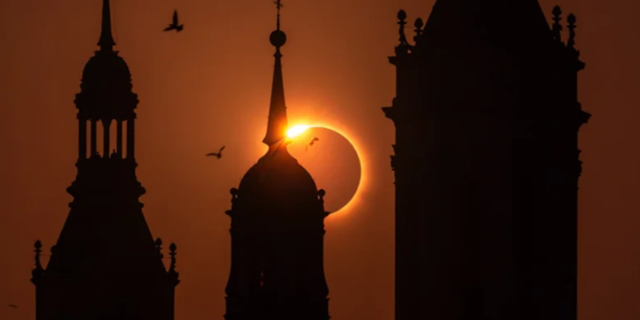
It was a moment of awe shared by millions across Europe: an eclipse that blocked out the sun, plunging parts of the continent into a daytime darkness in which temperatures dropped.
The eclipse began in the remote Arctic north, tracing an arc over much of western Europe. From the UK to northern Italy, tens of millions of people turned to the sky as the light of the setting sun was swallowed up.
The most sought-after spots were in Iceland and Spain, where totality – when the moon completely covers the sun's light – drew millions of locals and tourists into the path of the eclipse.
In Iceland, people flocked by air, land and sea to take in the country's first total solar eclipse in 72 years. Amid concerns that clouds would block the view, a record 31 cruise ships plied the waters off the west coast, carrying about 53,000 passengers and crew.
Iceland's eclipse-themed events included a day-long music festival hosted by the artist Björk, whose 10-hour set list set aside two minutes for totality. Every ticket came with a pair of approved solar eclipse glasses.
In Spain, where some of the best views were expected, more than 450,000 tourists had arrived from as far as Canada and Australia, crisscrossing the country by train, bus and caravan to stake out the perfect viewing spot.
"It was one of the most beautiful things I've ever seen in my life," Sara García Alonso, a reserve astronaut for the European Space Agency, told broadcaster RTVE. "It gave me goosebumps."
"Our car was cancelled," one woman who had travelled from Brazil with her sister said on social media. "So we took a three-hour bus, a 20-minute taxi and two-hour hike. Arrived at the location!"
Spanish officials estimated that as many as 6 million people would flock to the path of the eclipse. Just hours before it began, amid frenzied debate about weather forecasts, officials reported traffic jams on the major roads out of Madrid and Barcelona.
Others took their chances in the cities. In Madrid's Parque del Oeste, hundreds gathered to watch the eclipse, and the crowd burst into raucous cheers.
César González, an astronomer at the Madrid Planetarium, called it "a spectacular experience". "In broad daylight, the light dims to a point where you can see the brightest stars in the sky. When totality starts, the temperature drops several degrees. And all of this lasts a few minutes – in this case around 1 minute and 45 seconds."
Across Europe, the eclipse forged ad hoc communities, as people came together to witness one of nature's great wonders.
In Camberwell, south London, an impromptu crowd of all ages gathered in Brunswick Park to try different ways of seeing the eclipse, which reached 92% totality. Some held up colanders, others a spatula with holes, still others pinhole cameras made of old candy boxes.
A woman in her 70s said she had worked at an observatory for 30 years. "What a surprise to find an actual refractor," she said, pointing to a telescope with a solar filter taped on the end. "It's like a wonderful gift."
Later, as the eclipse passed its peak and the sun began to set for real, dozens of neighbours who had never previously spoken to each other stayed on picnic blankets to swap photos.