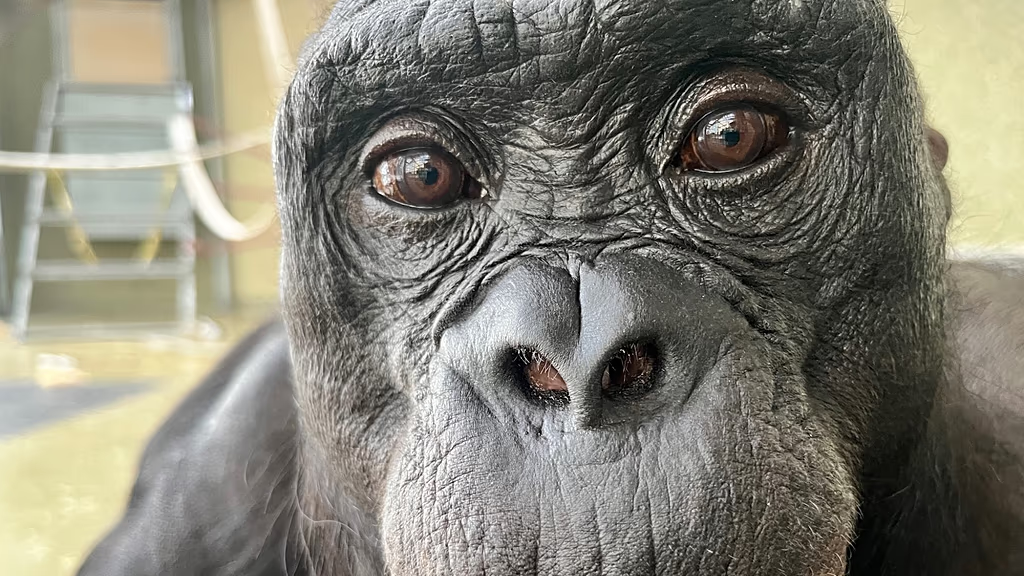
Scientists sat across from a 43-year-old bonobo called Kanzi to have an imaginary tea party.
The ability to imagine has long been thought of as uniquely human - but scientists have discovered that apes can also extend their mental lives "beyond the here and now".
In a series of tea party-like experiments, researchers at Johns Hopkins University in the US demonstrated for the first time that apes can use their imagination and "play pretend". One bonobo engaged with cups of imaginary juice and bowls of pretend grapes, in a similar way you'd expect a toddler to.
A tea party for apes
The researchers created experiments very similar to a child's tea party to test a 43-year-old bonobo called Kanzi.
In each test, an experimenter and Kanzi faced each other across a table set with either empty pitchers and cups or bowls and jars. In the first task, there were two empty, transparent cups on the table alongside an empty transparent pitcher.
The experimenter tipped the pitcher to "pour" a little pretend juice into each cup, then mimed dumping the juice out of one cup. They then asked Kanzi: "Where's the juice?"
The ape pointed to the correct cup that still contained pretend juice most of the time, even when the experimenter changed the location of the cup filled with pretend juice.
In case Kanzi thought there was real juice in the cup, even if he couldn't see it, the team ran a second experiment. This time there was a cup of real juice alongside the cup of pretend juice. When Kanzi was asked what he wanted, he pointed toward the real juice almost every time.
"It's extremely striking and very exciting that the data seem to suggest that apes, in their minds, can conceive of things that are not there," Bastos says. "Kanzi is able to generate an idea of this pretend object and at the same time know it's not real."
While Kanzi wasn't perfect in his answers, he was consistently correct.
"Imagination is one of those things that in humans gives us a rich mental life. And if some roots of imagination are shared with apes, that should make people question their assumption that other animals are just living robotic lifestyles constrained to the present," Krupenye adds. "We should be compelled by these findings to care for these creatures with rich and beautiful minds and ensure they continue to exist."