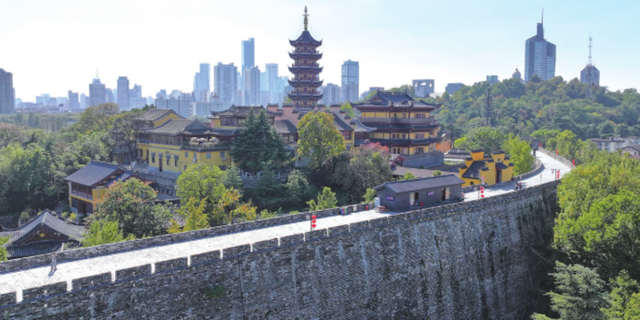
Six hundred and sixty years ago, as the Ming Dynasty (1368-1644) was taking shape, an ancient city wall began rising brick by brick in Nanjing, East China's Jiangsu Province. The wall once ran about 35 kilometers around the city, and 25 kilometers of it still stand. Each brick was engraved with the names of the craftsman who made it and the official who supervised the work, forming China's largest existing "open-air library of brick inscriptions." Over the centuries, many of those bricks drifted away from the wall and ended up scattered among ordinary households.
Today, a public initiative called "Bring Each Brick Home" is gathering them back from streets, neighborhoods, and construction sites, and setting them back into the wall.
Zhao Mengwei, a researcher at the Nanjing City Wall Protection and Management Center, said the collection work keeps turning up family stories. "People tell us about their ties to the wall or their family histories, and are often moved to tears. For those who have left Nanjing, the city wall also stands for their hometown. This emotional connection ensures cultural heritage is no longer cold and distant," she said.
Over the years, many Nanjing residents have taken it upon themselves to search for and return city wall bricks. Xie Zhuru, now in her 90s, had long cared about the wall's protection. She and her husband had collected scattered bricks, strapping them to their bicycle and storing them at home. When Xie heard about the project, she immediately contacted the staff and donated all 12 bricks from her personal collection.
In 2017, volunteer Dong Yueming began to patrol a factory wall built from ancient city bricks. For over seven years, he urged the people living around it to protect the bricks and wait for the day the bricks could go back. He brought a water bottle on each visit to wash away the dust, so the inscriptions would be clear enough to read and photograph. After the factory was finally abandoned, about 20,000 bricks were recovered.
Over the past 10 years, the public has submitted hundreds of useful clues, and more than 600,000 city wall bricks have come home.
Every clue sends someone out to the site, often to a demolition yard where there is little time, and the bricks come down by hand rather than by machine, so nothing cracks.
The bricks Dong rinsed clean end up in storage with all the rest, and there the inscriptions he kept photographing are read one more time, character by character. Xiao Fahua, a deputy director at the Nanjing City Wall Museum, said a team uses digital technology to copy them into a database that now holds tens of thousands of inscriptions.
So a line of marks that had sat unreadable under factory dust becomes a record anyone can look up: the man who made the brick, the official who checked his work, and the place it came from. "Through the inscriptions, we can know the origin of each brick and who made it," Xiao said.
The database will hold those names for good. The wall itself, though, still comes back one brick at a time: from a woman in her 90s handing over the 12 bricks she and her husband once carried home on a bicycle, and from a volunteer pouring water over a dusty inscription until the name of the craftsman who made that brick, 660 years ago, can be read again.