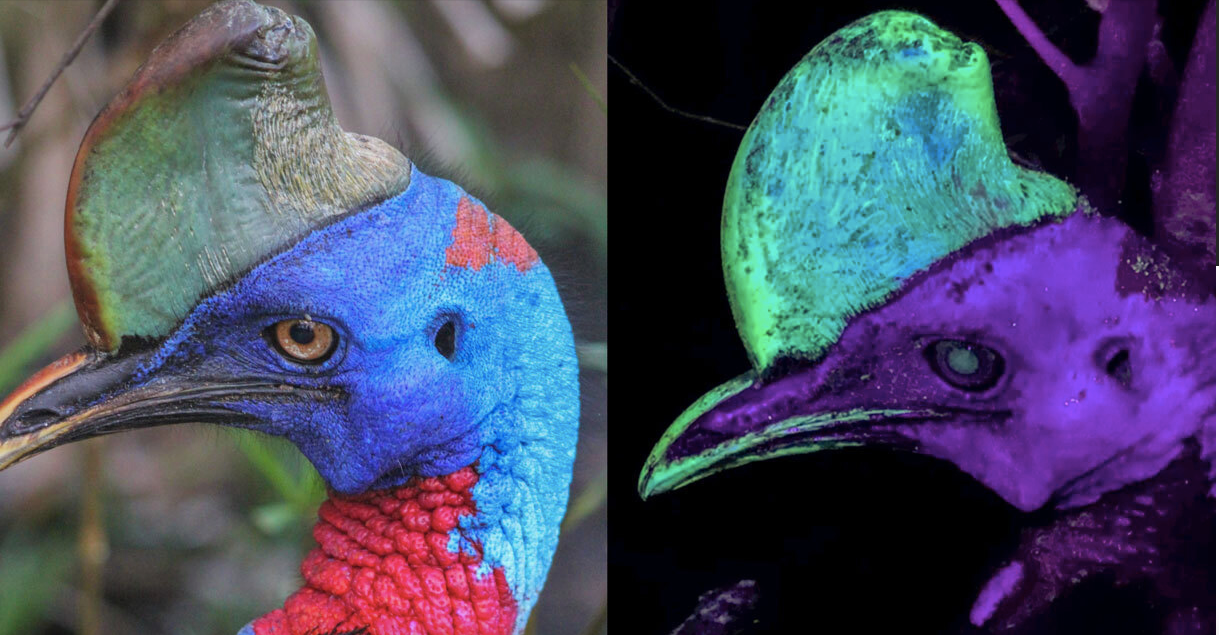
Often labeled "the world's most dangerous birds," cassowaries just got even more intriguing. The aggressive, flightless birds have structures on top of their heads called casques, the purpose of which has long confused scientists. To the human eye, casques look fairly plain — but new research published last month in Scientific Reports finds this headgear fluoresces under ultraviolet (UV) light, possibly aiding the birds' visual displays.
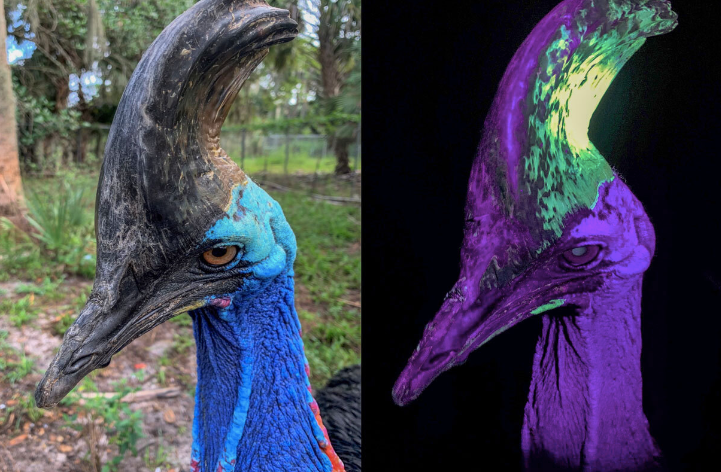
When researchers examined casques under UV light, they discovered the structures' outermost sheath of keratin — like the protein that makes our fingernails and hair — fluoresced, with different species of cassowaries each giving off a distinct pattern. No matter the species, whether the northern cassowary (above) or the southern cassowary (below), the glow theoretically fell in the range of wavelengths of light that cassowaries can see. But it's not yet certain whether the birds can perceive a difference in the patterns, says co-author Todd Green, an anatomist and paleontologist at the New York Institute of Technology.
Although the casques' function is still unclear, Green notes that the height casques add to the birds might help them intimidate any intruders on their territories. He adds that this work may apply to all animals with mysterious head ornaments, not just cassowaries. "If we can come to understand what modern animals are using this strange headgear for," he says, "we can take it back into the fossil record to better understand extinct dinosaurs."