Rock hyraxes, known in southern Africa more often as "dassies", are furry, thickset creatures with short legs and no discernible tails. They spend much of their time sunning themselves on rocky outcrops.
Another thing they sometimes do is drag their butts along the ground. Dog owners know that this behaviour can be a sign of parasitic infections; in hyraxes the reason seems to be less clear, but this action leaves distinctive traces in sandy areas.
Traces and tracks — ancient, fossilised ones — are what we study at the African Centre for Coastal Palaeoscience through the Cape south coast ichnology project. Over the past few decades, we have found almost 400 vertebrate tracksites on this coast, some as old as 400,000 years, in cemented dunes from the Pleistocene epoch — a period lasting from about 2.58 million years ago to about 11,700 years ago.
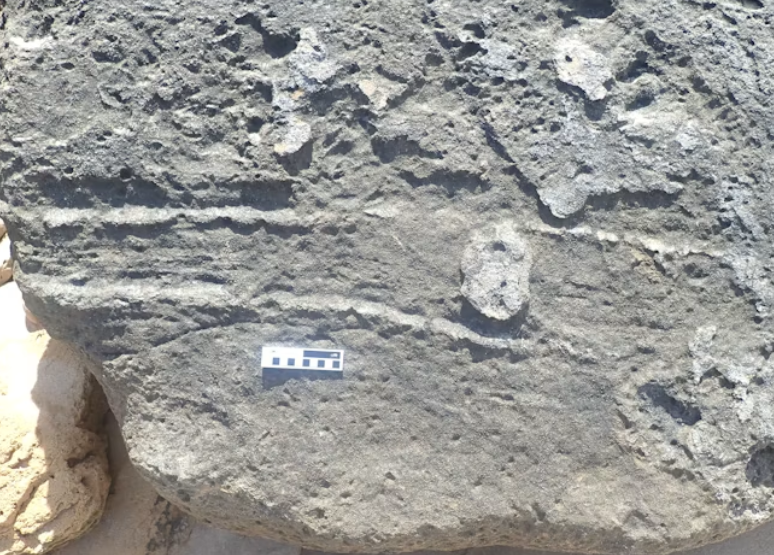
Among our latest finds are two fossilised traces that appear to have been made by rock hyraxes long ago. One is a tracksite and the other is a butt-drag impression with what may be a fossilised dropping in it.
The probable tracksite, near Walker Bay on the Cape south coast, is around 76,000 years old. The probable butt-drag impression, found east of Still Bay on the same coast, is most likely around 126,000 years old.
The butt-drag impression is the first fossil of its kind to be described from anywhere in the world. These are also the only possible fossilised hyrax tracks ever to be identified.
Interpreting the drag mark
The butt-drag impression is 95cm long and 13cm wide, containing five parallel striations. Its outer margins are slightly raised, and within it there is a small raised feature measuring 10cm by 9cm. Clearly something was dragged across the surface when it consisted of loose sand.
We considered possible causes other than hyrax buttocks — a leopard or an ancestral human dragging prey, or perhaps an elephant dragging its trunk. However, these would be expected to leave tracks, and the raised feature within the impression would be hard to explain.
If it was a hyrax, it would make sense: the buttock trace would have come after the tracks and wiped them out. And the raised feature might be a coprolite — a fused, fossilised mass of hyrax droppings.
Old dung and urine
Rock hyraxes leave much more than just tracks and butt-drag traces. Because they prefer rocky areas, their tracks are not often found, but they polish rock surfaces to a shiny finish — similar to what buffalo on the North American prairie do with rubbing stones.
Hyraxes also leave deposits of urine and dung. Urea and electrolytes are concentrated in their urine, and they excrete large amounts of calcium carbonate, which becomes cemented and forms whitish deposits on rock surfaces. Due to their communal habits, hyraxes often urinate in the same preferred spots over multiple generations.
Their urine and dung often mix to form a substance known as hyraceum — a rock-like mass that can accumulate into extensive, dark, tarry deposits. Hyraceum has been used as a traditional medication to treat a variety of ailments, including epilepsy and for gynaecological purposes.
Hyraceum may be tens of thousands of years old, and can be regarded as a threatened, non-renewable resource. These deposits, being sensitive to environmental changes and containing fossil pollen and other evidence of ancient life, form valuable natural archives for interpreting past climates, vegetation and ecology.
Although fossilised urine is globally uncommon, there is a word to describe it: "urolite", to distinguish it from "coprolite" (fossilised poop). It seems that hyraxes contribute the lion's share of the world's urolite.
Through appreciating the importance of butt-drag impressions, urolites, coprolites and hyraceum, we will never view these endearing creatures in the same light again.