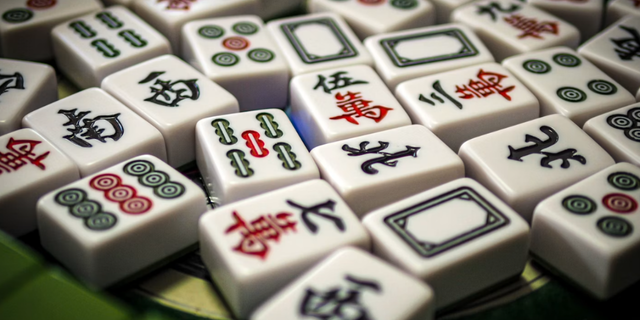
There is a room in Brooklyn where thirty Americans in their twenties are staring hard at small ceramic rectangles, trying to read Chinese.
They would not describe it that way. They would say they are playing mahjong. But the tiles in their hands are printed with 一, 二, 三 and the character for ten thousand, and by the end of the evening most of them can recognise these on sight — faster, as it happens, than a first-year language student.
That is the quiet joke of America's mahjong revival. The country has fallen for a game that has never once pretended to be anything other than Chinese.
The tiles carry their origins
Mahjong took shape in nineteenth-century China, and the set has never disguised where it comes from.
The three suits are bamboo, circles and Chinese characters. The honour tiles name the four winds — east, south, west, north — and the dragons. There is no translated edition, no localised version with English lettering. To play at all, you learn to read the tiles, and the tiles are in Chinese.
Even the name points home. It is said the game was named for a sound: the Chinese word refers to sparrows, and a hundred and forty-four tiles being shuffled across a felt mat by four pairs of hands does sound a little like a flock of them landing at once.
How it crossed the ocean
The game reached the United States in the 1920s, carried back by an American businessman who had been working in China and who then set about teaching his countrymen to play.
It caught on immediately. Department stores filled their windows with tile sets. Magazines ran photographs of players gathered around ornate boards. Owning a mahjong set became a mark of worldliness, and for a few years the country was, by any reasonable measure, obsessed.
A local variant grew out of that first wave and is still played today: an American version organised around a printed card of preset winning hands, reissued each year, so the targets change annually and every player has to relearn them together. It is one branch among many. Worldwide there are more than forty recognised variations, and within China alone the rules shift from province to province — enough difference that a confident player from one city can sit down in another and find themselves a beginner again.
And now, the second wave
A century after that first craze, it is happening again.
Game cafés, private clubs and bar nights built around mahjong have been multiplying across American cities. New York has led the way, but clubs and instructional leagues have appeared in Los Angeles, San Francisco and Chicago too, and organisers report that younger players account for a large share of new interest. Online platforms have seen a matching surge, as beginners use digital tables to learn the rules and to play with friends who live elsewhere.
The people filling those seats are largely in their twenties and thirties — a group with no particular attachment to the game's old American reputation as something played by retirees.
Four people, one table, no notifications
Ask them what pulled them in and the answer is remarkably consistent, and it is not really about the rules.
Mahjong is stubbornly analog. The tiles have weight. You stack them into walls with your hands. Nothing loads, nothing buffers, nothing queues up the next thing automatically. In an era of fragmented attention and passive entertainment, an activity that demands your whole face for two hours has become a selling point on its own.
Underneath that, the game is genuinely deep. It blends memory, pattern recognition and calculated risk: you track what has been discarded, infer what the other three are collecting, and decide constantly whether to commit to the hand you have or abandon it for a better one. In strategic depth it has more in common with poker than most newcomers expect, which is why serious players stay interested for decades rather than months.
There is also a structural reason it spreads. Mahjong needs four people. Not two, not however many happen to turn up — four. That requirement quietly organises everyone's calendar. You cannot play unless you gather, so you gather, and then you gather again.
Which may be the most Chinese thing about it. The game was built for a round table, a long evening and three other faces, and it has carried that design across an ocean and a century without adjusting. Americans are now discovering what players in China have never needed explaining: the tiles are the excuse, and the three people opposite are the point.