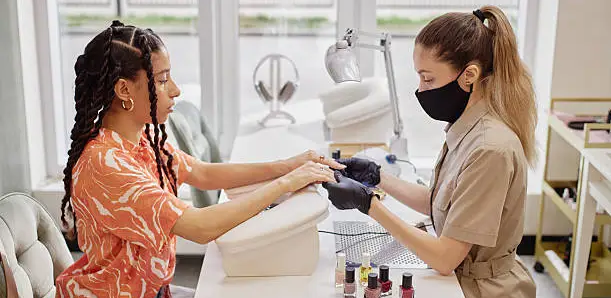
Hair and beauty salons are spaces where we go to look and feel good. We have a bad day, a bad week, a bad breakup — we go to the salon. But ask any hair or beauty worker about what their job involves and they'll tell you the work to help clients feel good goes well beyond cutting hair or painting nails.
Salon work involves care for emotions (via talk), care for bodies (via touch) and care for identities (via aesthetic transformation). It's not just about technical skills alone, it involves complex social and emotional skills to manage all three.
It's these three aspects that have emerged clearly from my latest research interviewing and surveying hundreds of hair and beauty workers — and their clients.
These three aspects — emotion, body and identity — are all dimensions of "care" in the salon. So when it comes to visiting salons, what we often call as "self-care" involves other people doing care work for us.
And while we may pay for our treatment, there's a mental and emotional cost for the salon workers that isn't spoken about enough.
The first port of call
Not all salon conversations verge into challenging territory, but every salon worker I have interviewed said that difficult disclosures from clients are a regular part of the job.
This can range from talk about grief and loss, challenges with mental health or even experiences of abuse and domestic violence.
Often when clients are upset about something, the first place they'll think to go is the salon.
For one ex-hairdresser who worked across from a hospital, this meant having some pretty tough conversations.
I had terminally ill patients coming in to me who were going to die in the next couple of weeks. Young girls in their 20s who had cancer, they'd come in, and I would be their only source of contact with the outside world. They'd be let out for one hour before they'd have to go back to the hospital and they knew they were going to die.
This might sound like an extreme example, but my research suggests there's something unique about hair and beauty salon work that means people feel comfortable sharing deeply personal information.
Factors like the length and recurrence of visits, and the physical intimacy involved can encourage a level of trust and loyalty in the relationship.
The relationship between salon workers and clients is often professionally distant yet physically and emotionally close — and all this adds up to clients disclosing intimate aspects of their lives.
Obviously, most salon workers are not trained therapists. Though strangely, this means people may be likely to disclose even more.
Unlike a therapist, who might challenge your thinking or apply various therapeutic models, a salon worker usually only listens and affirms.
There is also a lower barrier to entry — it might be easier to find a salon worker than a therapist, it doesn't require a referral and it's likely to be cheaper.
The 'everyday influencers'
Increasingly, health and other services around the world are recognizing the unique role that salon workers play in their clients' lives and in communities.
There are now programs training hair and beauty workers to connect clients to domestic violence services, talk with their clients about health issues like family planning and even to act as "everyday influencers" on topics like climate change.
In Australia, these kinds of training programs are ad hoc and non-mandatory, usually occurring after formal qualifications, and often focusing on specific issues like identifying abuse.
Research suggests that when it comes to the care salon workers are expected to provide, the current lack of training, support and resources for salon workers is strongly connected to experiences of burnout in the industry.
What's more, people frequently enter the sector at a very young age and with little preparation or support for the emotional labor the job demands.