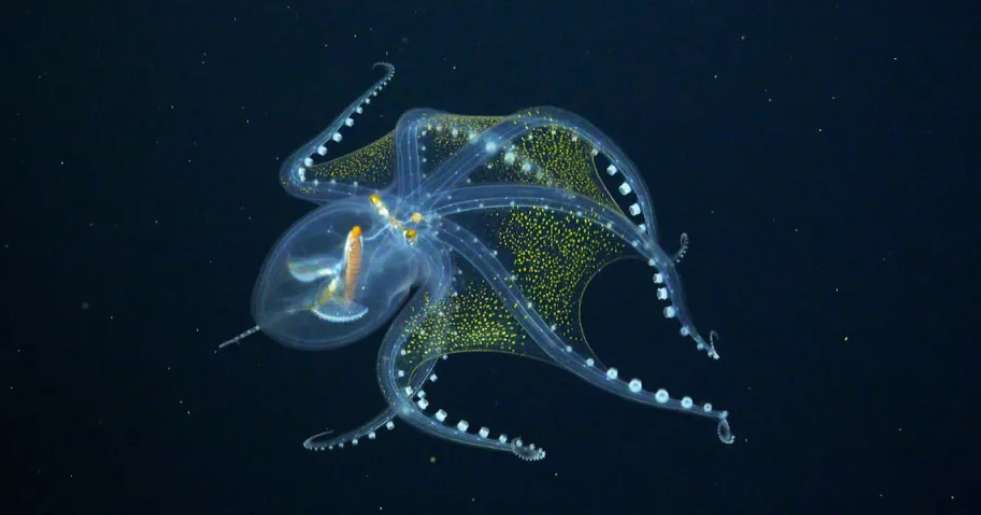
Large apex predators dominated the waters of a distant geological era — think giant reptiles and kraken-like octopuses as long as a five-story building. The latter included certain species, some of which may have reached breath-taking lengths and feasted upon other large creatures. A new paper not only extends the record for the earliest known octopus by millions of years, but suggests some were hunters that sat at the very top of the food chain. "This study provides the first direct evidence that invertebrates could evolve into giant, intelligent apex predators in ecosystems that have been dominated by vertebrates for about 400 million years," Professor Yasuhiro Iba said in a press release. "Our findings show that powerful jaws and the loss of superficial skeletons, common characteristics of octopuses and marine vertebrates, were essential to becoming huge, intelligent marine predators."
Estimating the Kraken-Like Octopus Body Size
For this study, researchers analyzed octopus jaws from various locations. This included fossils belonging to a group of finned octopuses, called Cirrata, discovered with digital fossil-mining techniques that involve high-resolution grinding tomography and artificial intelligence. By comparing jaw lengths to the proportions of modern-day finned octopuses, the team could estimate the octopus's total body size. The researchers identified two species. One is thought to have lived millions of years ago and would have reached lengths comparable to the giant marine reptiles of the time. According to the team's estimates, individuals could grow to significant sizes. The other species is an older and smaller species, existing millions of years ago. With lengths ranging between sizes, its dimensions were substantial.
Determining the Ancient Octopus Diet
The jaws also offer clues to the ancient sea creatures' food preferences. Even well-preserved jaws showed signs of wear, suggesting a diet consisting of large animals. The sheer amount of wear was one of the most surprising findings. "In well-grown specimens, a portion of the jaw tip relative to the total jaw length had been worn away, which is larger than that seen in modern cephalopods that feed on hard-shelled prey," Iba explained in a press release. "This indicates repeated interactions with their prey, revealing an unexpectedly aggressive feeding strategy." Wear patterns also show a preference for using one side of the jaw over another. This, researchers say, suggests the octopuses were displaying complex behavior that signals advanced intelligence.
A Real-Life Kraken?
For centuries, sailors around the world have feared krakens and other mythical cephalopods. It is thought that these legends were inspired by sightings of large marine species. This new piece of research adds a new layer to the story — even if these species were long gone before humans took to the oceans. Contrary to previous narratives, it appears marine invertebrates took on a larger, more predatory role during the Late Cretaceous, and these ancient cephalopods were already starting to show signs of intelligence.