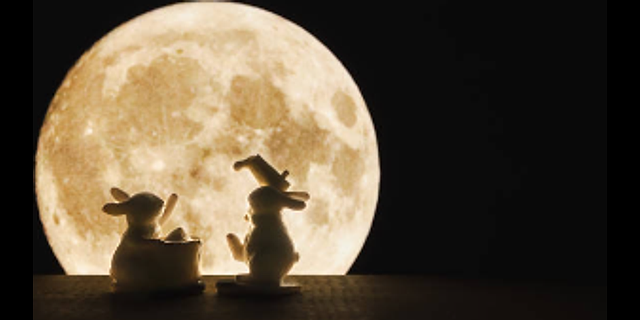
On the night of Sept. 25, families celebrating the Mid-Autumn Festival will look up at a moon that seems almost perfectly round. Astronomically, however, it will not be full yet. In Beijing time, the moon will reach its exact full phase at 12:49 a.m. on Sept. 27, two calendar dates after the festival.
That difference may sound surprising. After all, the Mid-Autumn Festival falls on the 15th day of the eighth month in the traditional Chinese calendar, and the 15th is closely associated with the full moon. But a date on a calendar and an astronomical event are not quite the same thing.
A lunar month begins on the date that contains the moment of the new moon. In September 2026, the new moon occurs on Sept. 11, making that date the first day of the eighth lunar month. Counting forward places the 15th day on Sept. 25.
The full moon, by contrast, is defined by the exact positions of the sun, Earth and moon. It occurs when the moon is opposite the sun in Earth's sky. Because the moon's orbit does not fit neatly into whole calendar days, that moment does not always fall on the 15th day of a lunar month. The Hong Kong Observatory's 2026 calendar therefore marks Sept. 25 as the 15th lunar day and Sept. 27 as the full moon.
Such gaps are normal, although a difference of two calendar days is less common. According to the National Astronomical Observatory of Japan, the previous two-day difference occurred in 2017, and the next one will come in 2043.
The good news is that the difference will be difficult to notice without careful measurement. On Sept. 25, the moon will already be about 99% illuminated, so it should still look full to most people. The festival view will not be spoiled simply because the astronomical full moon comes later.
September's full moon is also known as the Harvest Moon because it is the full moon closest to the September equinox. When it rises near the eastern horizon, it may look yellow or orange. This color appears because its light travels through more of Earth's atmosphere near the horizon, where shorter blue wavelengths are scattered more strongly. As the moon climbs higher, the warm color gradually fades.
The moon can also seem unusually large near the horizon. This is called the Moon Illusion: nearby buildings, trees and other familiar objects make the lunar disk look bigger than it does high in the sky, even though its actual size has not suddenly changed.
So this year's Mid-Autumn moon is not truly late. The festival and the full moon simply follow two related but different clocks. One is set by the days of the traditional calendar; the other, by the constantly changing positions of three bodies in space.