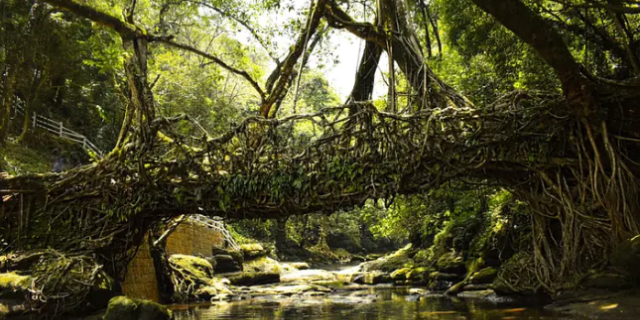
In northeastern India, building a bridge can begin with planting a tree — and end several generations later.
People in the state of Meghalaya guide the flexible roots of rubber trees across rivers and deep gaps. Over 10 or 15 years, the roots grow stronger and gradually form a living bridge. Unlike wooden structures, which quickly rot in the region's constant dampness, these bridges can survive for centuries.
They are a remarkable answer to an equally remarkable climate.
Twelve times Seattle's rain
The village of Mawsynram receives about 467 inches of rain in an average year, roughly 12 times Seattle's annual total. Most of it falls during the monsoon season from June to September, when rain can arrive every day.
Residents protect themselves with knups, cone-shaped covers made from bamboo and banana leaves. Worn over the head and back, they leave both hands free for farming and other work — something an ordinary umbrella cannot do as easily.
Nearby Cherrapunji receives almost as much rain. It also holds an extraordinary historical record: Between August 1860 and July 1861, more than 1,000 inches fell there.
Why is this corner of India so wet? Moist monsoon air moves north from the Bay of Bengal and meets the steep hills of Meghalaya. Forced upward, the air cools, and its moisture falls as rain.
The rainiest neighbourhoods on Earth
A similar combination of warm ocean air and high ground creates extremely wet communities elsewhere.
Tutunendo, on Colombia's Pacific side, receives rain during much of the year and has two rainy seasons. Fewer than 1,000 people live there, surrounded by dense tropical vegetation. The rain supports extraordinary biodiversity, though it also brings high humidity and the danger of landslides.
Across the Atlantic, the village of Ureca lies on the southern end of Bioko Island. Its black-sand beaches and waterfalls receive around 411 inches of rain annually. The rainy season usually stretches from April to October, but clouds and showers can appear throughout the year.
Debundscha, in Cameroon, sits at the foot of Mount Cameroon. Warm, moisture-filled air is pushed up the mountain, cools and releases heavy rain on the village below. Bananas, plantains and palms grow well in its wet, fertile soil.
Life in these places is not one endless cozy afternoon beside a window. Heavy rain can damage roads, trigger landslides and make travel difficult. Yet it also feeds forests, rivers, waterfalls and farms.
The residents have not defeated the weather. They have learned to build with it, dress for it and grow food in it. In Mawsynram, they have gone one step further: They let the rain help grow the bridges beneath their feet.