Deep in the maze of Beijing's hutong (alleyways), inside a lived-in siheyuan (enclosed courtyard), the air is thick with steam and the steady crackle of fire. A wok flashes over an open flame.
Leaning toward a slightly trembling phone camera, a nearly 70-year-old chef speaks in a warm Beijing drawl: "Watch this step carefully — this is called coating. Don't lose focus."
To millions online, he is simply "Second Uncle". In real life, he is Sun Lixin — once the executive chef of the century-old restaurant Bianyifang, best known for its Peking duck, and a veteran of countless state banquets.
In 2019, alongside Zheng Xiusheng, the former executive chef of a well-known Beijing hotel, he co-founded "Lao Fan Gu", a moniker meaning veteran master chefs. On a popular short-video platform, the duo's account has since drawn more than 16 million followers.
Born in 1956, Sun stepped into the kitchen straight out of middle school. His formative years were shaped by Tuo Dailiang, a revered Sichuan cuisine master. At 16, Sun learned his first dish, Kung Pao Chicken, and never strayed far from its disciplined principles: a balance of numbing spice, heat, savoriness and a subtle sweet-sour finish; precision in knife work; and harmony in texture.
"My master was always extremely low-key," Sun recalls. "He told me not to chase fame, just focus on making every meal well."
That philosophy would later define Sun's own career. By his 20s, he had already risen to head chef at one of China's earliest modern hotels.
One of his most unlikely legacies is a dish now found on menus across China: blueberry yam. While preparing a traditional dish of osmanthus yam strips, Sun found that scraps were inevitably discarded. Unwilling to waste them, he steamed and mashed the leftovers.
The result was bland — until he borrowed from Western pastry techniques, adding whipped cream and condensed milk, then finishing the delicate mounds with blueberry sauce. What began as an anti-waste experiment became a nationwide staple.
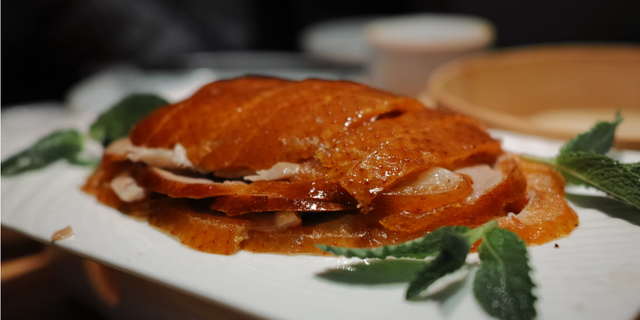
Sun's reinvention of roast duck was a deliberate, years-long pursuit. At Bianyifang, he noticed a shift in diners' expectations toward healthier eating. Starting in 2003, he worked with nutrition experts to overhaul the process, replacing traditional marinades with vegetable juices. The result was a technique he describes as "roasting outside, simmering inside", producing a duck that was lower in fat while retaining its signature depth of flavor.
"Preserving tradition doesn't mean refusing changes," he says. "You keep the roots, but give them new life for today."
In 2019, Sun turned to a different audience: home cooks. Early videos were sprawling, sometimes stretching a single dish across dozens of episodes. Viewers lost patience, so the team condensed each lesson into concise, digestible segments.
What sets "Lao Fan Gu" apart is not production polish — there are no studio lights or staged backdrops — but authenticity. Filmed in a real, working home kitchen, the videos capture Sun and Zheng in constant motion, joking like crosstalk performers as they cook. Fans have dubbed it "the crosstalk kitchen".
Yet beneath the humor lies rigor: even a stray piece of jujube skin, Sun notes, would count as a serious mistake in a professional kitchen.
"If it's too technical, beginners can't follow it," Sun says. "If it's too simple, professionals don't learn anything." The solution was a dual-layered approach: precise breakdowns of advanced techniques alongside plainspoken explanations in everyday language.
One user commented under a braised pork ribs video: "So detailed! I followed your recipe today — my ribs are stewing now, can't wait." Hours later, he added: "It's delicious. I used to add so many seasonings, but this simple version tastes even better."
"Cooking is a kind of glue for family harmony," Sun reflects. "That's the real meaning behind our motto: we cook well, and you eat well."
Over the years, other veteran chefs and younger apprentices have joined the project, continuing the intergenerational relay of culinary knowledge.
From a teenage apprentice to a master of state banquets, and now a mentor to millions of home cooks, his journey reflects a quiet arc of return. The techniques may be refined, the platforms modern, but the purpose is unchanged.
"In fact, banquet menus are quite simple, with many dishes using everyday ingredients," Zheng once said. "We hope people can learn them and re-create them at family gatherings, passing them down through generations."
In kitchens far from Beijing's hutong, in the glow of phone screens and the rhythm of home stoves, Sun and his team continue to translate the grandeur of the banquet table into something intimate, repeatable and alive — one dish, one family, one generation at a time.