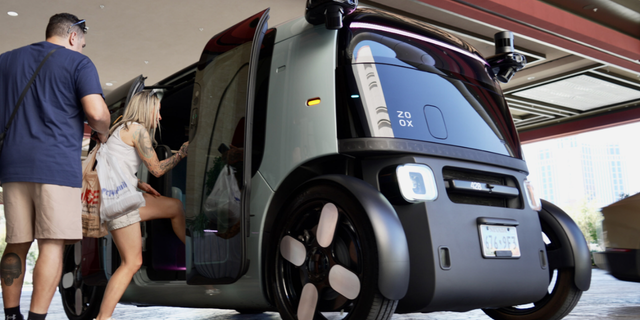
When Chloe got into a small, boxy vehicle in the middle of a busy city strip, something felt immediately different. There was no driver. There was no steering wheel. And yet the car moved smoothly through traffic, playing music and adjusting the temperature on request.
"It's kind of scary at first, but when I just got used to it, it's really cool," she said after the ride. "I really liked the music and how you can adjust the temperature."
This kind of experience is becoming more common as self-driving taxis — called robotaxis — inch toward the mainstream. For years, these vehicles have operated with human safety drivers or at least with steering wheels and pedals in place, just in case. But that is starting to change.
No Steering Wheel, No Problem?
Amazon's self-driving vehicle company, Zoox, recently received approval to begin charging customers for rides in cars with no steering wheel or foot pedals. The vehicles feature four inward-facing seats — passengers face each other rather than the road ahead. Zoox had already been offering free rides in two major cities, and can now expand into paid service once it secures local approval.
Transportation regulators say the moment has arrived to update vehicle safety rules that were written decades ago, when a human driver was always assumed to be behind the wheel.
"If you're developing a standard in the 1970s, 80s, or 90s, nobody had a crystal ball that you might have technologies that would enable the vehicle to drive itself," said the head of the regulatory agency overseeing road safety.
Regulators have also proposed a separate rule that would allow robotaxis to operate without brake pedals — though that change is still under review.
Safety Concerns Remain
Not everyone is reassured. A road safety advocacy group raised concerns about Zoox's approval, saying the company had not provided enough data to prove its vehicles could operate safely on public roads.
"Lots of promises, lots of glossy language," said the group's legal director. "Yet there really was no data behind the promises, and that's really concerning."
Officials acknowledge that robotaxis have had problems — vehicles stopping unexpectedly in the middle of the road, struggling to exit parking lots, or failing to respond correctly around school buses and emergency vehicles. But they say they respond quickly when such issues arise.
"By and large, we're really excited about the promise of this technology and we want to see that promise fulfilled," one official said.
Automotive safety researchers have also noted that it is difficult to assess the overall safety record of robotaxis because reporting requirements are inconsistent. Most companies do not disclose how many miles their vehicles have driven, making it nearly impossible to calculate meaningful crash rates.
A Growing Industry
Zoox is owned by Amazon, which paid over a billion dollars to acquire the self-driving startup. The company plans to eventually produce as many as 10,000 robotaxis per year. For now, it is permitted to deploy up to 2,500 vehicles without steering wheels over the next two years as it works to demonstrate the technology's safety. More than half a million people have already ridden in its vehicles.
The robotaxi industry is expanding quickly. Zoox and Tesla are working to catch up with Waymo — currently the industry leader — which is owned by Alphabet, Google's parent company.
"This achievement reflects a shared commitment to enabling innovation while maintaining the highest standards of safety," said Zoox's CEO.
What Comes Next?
The question of whether robotaxis are truly safe remains open. Supporters argue that autonomous vehicles will never drive drunk or get distracted by a phone. Critics say the technology is moving faster than the safety evidence can keep up.
For now, passengers seem willing to try. A car with no one at the wheel — and no wheel at all — may take some getting used to. But for many riders, the novelty quickly gives way to something surprisingly ordinary: just being driven somewhere.